
It sounds impossible: an interest rate below zero, where you pay to lend money rather than earn on it. Yet several major central banks have done exactly this. Negative interest rates are an unconventional tool — a way to squeeze out more stimulus when rates are already at zero — with real effects on currencies and real limits on how far they can go. This guide explains negative interest rates: what they are, why central banks use them, how they affect the currency, the real-world examples, and where the policy hits its limits.
They're the sub-zero extension of how interest rates drive forex, a cousin of quantitative easing in the unconventional-policy toolkit, and they reshape the carry trade.
Key takeaways
Q: What are negative interest rates?
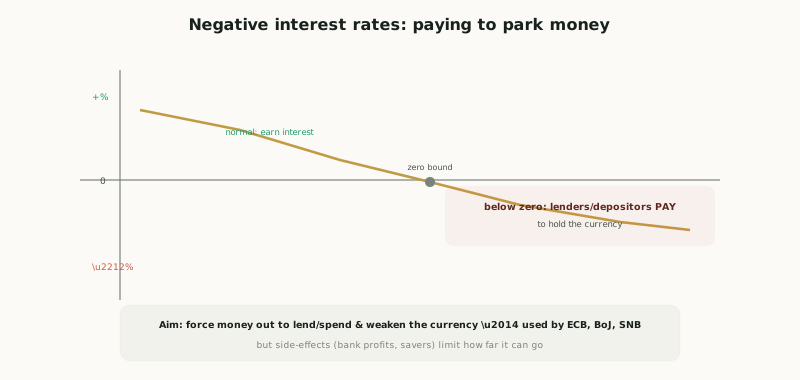
A: Negative interest rates (a negative interest rate policy, or NIRP) are when a central bank sets its key policy rate below zero. In practice this means commercial banks are charged to park excess reserves at the central bank, rather than earning interest — the normal relationship is inverted, so holding money costs you rather than paying you. It's an unconventional policy used to provide extra stimulus when rates are already at zero and the economy still needs support.
Q: Why would a central bank set rates below zero?
A: To stimulate a weak economy when conventional easing is exhausted. By penalising idle cash, negative rates aim to push banks to lend and businesses and households to spend or invest rather than hoard money. They also tend to weaken the currency — lower (or negative) yields make it less attractive to hold — which can help exporters and lift imported inflation. So fighting deflation, encouraging lending, and currency weakness are the main motivations.
Q: How do negative rates affect the currency?
A: Generally they weaken it, all else equal, because a currency offering negative or very low yields is less attractive to hold than higher-yielding alternatives — capital tends to flow toward better returns elsewhere. This is partly why negative rates appeal to central banks fighting deflation or wanting a more competitive exchange rate. But the effect isn't guaranteed: relative rates, risk sentiment and safe-haven flows all matter, and a negative-rate currency can still strengthen in a crisis if it's a safe haven.
What they are, and why
Negative interest rates (a negative interest rate policy, or NIRP) are when a central bank sets its key policy rate below zero. In practice, this most directly means commercial banks are charged to park their excess reserves at the central bank, rather than earning interest on them — the normal relationship is inverted, so holding money costs you rather than paying you. The logic, strange as it sounds, is a deliberate attempt to stimulate a weak economy when conventional easing is exhausted (rates already at zero, economy still struggling).
Negative interest rates at a glance
By penalising idle cash, negative rates aim to push banks to lend and businesses and households to spend or invest rather than hoard money that's now slowly shrinking — the goal being to fight deflation and revive demand. A second, closely related motivation is the currency: negative rates tend to weaken it, which can help exporters (cheaper goods abroad) and lift imported inflation (useful when fighting deflation). So the main drivers are fighting deflation, encouraging lending, and currency weakness — all pursued when the normal toolkit has run out of room.
The currency effect and the limits
For forex, the key question is how negative rates affect the currency, and the general answer is that they weaken it, all else equal. A currency offering negative or very low yields is less attractive to hold than higher-yielding alternatives, so capital tends to flow toward better returns elsewhere, putting downward pressure on the currency (this is the same rate-differential logic that drives currencies generally, just at the sub-zero extreme). It also reshapes the carry trade: a negative-rate currency becomes a natural funding currency (cheap, even profitable, to borrow), which adds to the selling pressure on it. This currency-weakening effect is partly why negative rates appeal to central banks fighting deflation or wanting a more competitive exchange rate. But the effect is not guaranteed: relative rates matter (if everyone has negative rates, the differential may not move much), and risk sentiment and safe-haven flows can dominate — strikingly, a negative-rate currency can still strengthen in a crisis if it's a safe haven (the Swiss franc and Japanese yen both held negative rates yet rallied in risk-off episodes, because flight-to-safety demand overwhelmed the yield disadvantage). So "negative rates weaken the currency" is a tendency, not a law.
Negative rates also have important limits and side-effects that constrain how far they can go — which is why they remain a controversial, last-resort tool rather than a routine one. The deepest limit is the physical cash alternative: if a bank or saver is charged too much to hold money electronically, they can (in principle) withdraw physical cash, which yields zero — better than negative — so there's an effective lower bound below which negative rates simply drive people into banknotes rather than spending (this is why rates have gone only modestly negative, not deeply). They also squeeze bank profitability (banks struggle to pass negative rates fully to depositors without triggering withdrawals, so the cost eats their margins, which can reduce rather than boost lending — the opposite of the intent), penalise savers and pension funds (a political and social cost), and risk encouraging cash hoarding and asset bubbles. The real-world record is mixed: the ECB, Bank of Japan, Swiss National Bank and others ran negative rates for years, with debatable success in reviving inflation and growth, and the side-effects fuelled ongoing debate about whether the policy is worth its costs. For traders, the practical takeaways are: a move to (or deeper into) negative rates is generally a dovish, currency-weakening signal; the policy makes a currency a funding currency for carry; but the effect can be overridden by safe-haven flows and relative-rate dynamics, so read it in context. As with all fundamentals, it's part of the why behind currency moves, not a standalone trade signal — combine with the broader rate/risk picture and sound risk management. The honest framing: negative interest rates (NIRP) set the policy rate below zero, so banks are charged to hold cash rather than earning — an unconventional, last-resort tool to force lending and spending, fight deflation and weaken the currency when rates are already at zero. They generally weaken the currency (negative yield is unattractive, and it becomes a carry-funding currency), but the effect isn't guaranteed — safe-haven flows and relative rates can override it (the franc and yen rallied despite negative rates). And they hit hard limits: the physical-cash lower bound, squeezed bank profits, penalised savers — which is why they go only modestly negative and remain controversial.
Trading around negative rates
For a trader, the most useful angle is what changes in a negative-rate regime tend to mean for the currency. A move to negative rates, or deeper into negative territory, is an unambiguously dovish easing signal — generally currency-negative, since it lowers the currency's yield further and signals the bank is straining for stimulus. Far more powerful, though, is the exit: when a central bank finally lifts rates back out of negative territory toward zero or positive, that's a major hawkish shift that can drive a large currency rally — because a currency that markets had treated as a perennial low/negative-yield funding currency suddenly becomes more attractive to hold. The Bank of Japan's eventual move away from negative rates is a textbook case: years of NIRP had entrenched the yen as the world's favourite funding currency, so the exit marked a significant regime change for the yen. The lesson is that the biggest negative-rate-related moves often come not from the policy itself (long since priced) but from shifts into or, especially, out of it.
Two further practical points. First, the relative picture is what matters: a currency's negative rate weakens it most when other currencies offer positive and rising yields (a wide, currency-negative differential); if many major economies are at or below zero together, the negative rate alone moves the currency less. Second, negative rates cement a currency's role as a carry-trade funding currency — cheap to borrow — which adds steady selling pressure in calm times but sets up the violent snap-back when carry trades unwind in a panic and the funding currency is bought back en masse (a recurring source of sharp moves in the yen and franc). And as always, NIRP decisions and signals carry event risk — markets watch closely for any hint of going deeper or exiting. The honest reminder: trade negative rates by watching the shifts — a move to/deeper into NIRP is dovish and currency-negative, while the exit back toward positive is a major hawkish move that can spark a large rally (the BoJ's exit and the yen); the effect depends on the relative picture (widest when others offer rising positive yields), the currency becomes a carry-funding currency prone to violent unwinds, and NIRP decisions carry event risk.
Negative interest rates (NIRP) set the policy rate below zero, so banks are charged to hold cash rather than earning — an unconventional, last-resort tool to force lending and spending, fight deflation, and weaken the currency when rates are already at zero. They generally weaken the currency (negative yield is unattractive, and it becomes a carry-funding currency), but the effect isn't guaranteed — safe-haven flows and relative rates can override it (the Swiss franc and yen rallied despite negative rates in risk-off episodes). And they hit hard limits: the physical-cash lower bound, squeezed bank profits, penalised savers — which is why rates go only modestly negative and the policy (ECB, BoJ, SNB) stays controversial. A dovish, currency-weakening signal — read in context, not as a standalone trade.