
A 1950s dancer turned trader, Nicolas Darvas, built a famous method around a simple idea: price moves in "boxes" of consolidation, and you buy the breakout from each box as a trend climbs. Famously turning a modest stake into a fortune while touring the world as a performer, his story made the Darvas box one of trading's enduring methods. It's an elegant, rule-based trend-following system — with the caveats every breakout method carries. This guide explains the Darvas box: the idea, the rules, and an honest look at its limits.
It's a structured form of breakout trading and trend following, conceptually close to Donchian channels and the Turtle system.
Key takeaways
Q: What is the Darvas box theory?
A: The Darvas box, devised by Nicolas Darvas in the 1950s, is a trend-following method that frames price as moving through a series of 'boxes' — ranges defined by a recent high (the box top) and low (the box bottom). When price breaks out above the top of its box, it's a buy signal; a new, higher box then forms, and the process repeats as the trend climbs, with a stop trailed below each box.
Q: How do you trade the Darvas box?
A: Identify a box: a consolidation where price has set a clear ceiling (the box top) and floor (the box bottom) over a period. Buy when price breaks decisively above the box top. Place a stop below the box (or its bottom). As price rises and forms a new box higher up, raise your stop under the new box, riding the trend box by box until a breakdown stops you out. It's essentially a structured breakout-and-trail system.
Q: Does the Darvas box still work?
A: The underlying logic — buying breakouts from consolidation in a trend and trailing stops — is sound and still used, but it's no magic formula. Like all breakout systems it suffers in choppy, range-bound markets where breakouts fail (whipsaws), and Darvas's own dramatic success came during a strong 1950s bull market, so survivorship and favourable conditions flatter the story. Treat it as one structured trend-following approach among many, with proper risk management.
The idea and the rules
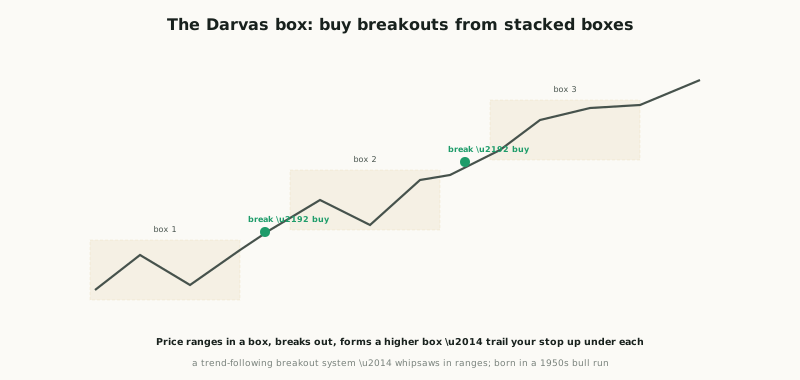
The Darvas box, devised by Nicolas Darvas in the 1950s, frames price as moving through a series of "boxes" — ranges defined by a recent high (the box top) and a recent low (the box bottom). The core logic: while price oscillates within a box it's consolidating (no action); when price breaks out above the top of its box, that's a buy signal; a new, higher box then forms, and the process repeats as the trend climbs, with a stop trailed below each box.
The Darvas box rules
In practice you identify a box by watching price set a ceiling (a high it repeatedly fails to exceed — the box top) and a floor (a low it holds — the box bottom) over a period, defining the range. You buy when price breaks decisively above the box top (a genuine breakout, not a brief poke). You place a stop below the box (commonly just under the box bottom, or under the breakout level), capping risk. Then, as price rises and forms a new box higher up, you raise your stop under the new box — riding the trend box by box, locking in more of the move with each step, until eventually a breakdown below a box stops you out and ends the ride. Stripped to its essence, it's a structured breakout-and-trail system: enter on strength out of consolidation, trail your stop up through successive consolidations, and let a strong trend carry you through several boxes.
An honest look at the limits
The Darvas box deserves respect — its underlying logic (buying breakouts from consolidation in a trend and trailing stops) is genuinely sound and still used today, and it elegantly encodes several good principles: trade with momentum, cut losses quickly (the stop under the box), let winners run (riding box to box), and act on objective, rule-based signals rather than emotion. The "box" framing is also a useful, intuitive way to read support and resistance and consolidation structure, and the method's kinship with Donchian channels and the Turtle system shows the durability of the breakout-and-trail idea across decades.
But it's no magic formula, and an honest assessment matters. Like all breakout systems, it suffers in choppy, range-bound markets, where breakouts repeatedly fail — price breaks the box top, you buy, and it falls back into the range, stopping you out (a whipsaw); a series of these false breakouts in a sideways market produces a string of small losses, which is the characteristic weakness of any breakout approach (see false breakouts and bull traps). The method shines in strong, sustained trends and struggles without them, so it must be matched to conditions. There's also an important survivorship and context caveat to Darvas's famous story: his dramatic success came during a powerful 1950s bull market, when a buy-breakouts-and-ride approach was especially favoured — so the spectacular results owe a lot to favourable conditions (and we hear his story precisely because it succeeded, the classic survivorship filter; the many who tried similar methods and failed wrote no bestsellers). None of this invalidates the method — it's a legitimate, well-structured trend-following breakout system — but it does mean treating it as one approach among many, not a guaranteed path to Darvas-like riches: apply it where trends actually exist, expect whipsaws in ranges, define your boxes and breakouts objectively (the "decisive" break is a judgement call worth specifying in your rules), and govern the whole thing with sound risk management and realistic expectations. The honest framing: the Darvas box is a 1950s trend-following breakout system — price moves through "boxes" (a defined high and low), you buy a decisive break above the box top, stop below the box, and trail your stop up under each new higher box, riding a trend box by box. Its logic (breakout-and-trail, cut losses, let winners run, rules over emotion) is sound and still used, but like all breakout systems it whipsaws in choppy ranges, and Darvas's famous success was flattered by a strong bull market and survivorship. Treat it as one structured approach for trending markets, with objective rules and proper risk management.
Applying it today
Translating Darvas's 1950s stock method to modern forex (or any market) takes a few sensible adaptations. Choose a timeframe that fits your style — the box logic works on daily charts for swing trading or intraday charts for shorter horizons — and recognise that boxes form on every timeframe. Define the box objectively: rather than eyeballing it, set rules for what counts as a box (e.g. a high and low that have each held for a minimum number of bars, within a maximum range width), so your entries are mechanical rather than subjective — the original method's discipline came precisely from clear, unemotional rules. Use volatility sensibly when defining the breakout: a small tolerance (for instance, a buffer based on ATR) above the box top helps distinguish a genuine break from noise poking through the edge, reducing false-breakout whipsaws. And because the method's great weakness is ranging markets, pairing it with a higher-timeframe trend filter (only taking box breakouts in the direction of the larger trend) dramatically cuts the whipsaw losses that plague pure breakout systems in chop. Some traders also take partial profits into strength while trailing the rest, balancing the "let winners run" ideal against the reality that not every box leads to another.
The deeper, lasting value of the Darvas box is less the literal system than the principles it crystallises — which is why it's still taught seventy years on. It teaches you to trade with momentum out of consolidation, to define risk objectively (the stop under the box), to let winners run by trailing rather than grabbing quick profits, and to act on rules, not feelings — all timeless, all transferable to other approaches on this site. Hold those principles in one hand and the romanticised story in the other: Darvas's world-touring, fortune-making tale is inspiring but survivorship-flattered and bull-market-aided, so admire the method's logic without expecting its legendary results. Used as a clear, rule-based, trend-filtered breakout system with honest expectations and real risk management, the Darvas box remains a perfectly respectable tool; treated as a magic money-machine because of one famous story, it will disappoint like any over-hyped method. The honest reminder: to apply Darvas today, pick a timeframe, define the box and breakout objectively (using a volatility/ATR buffer to filter noise), add a higher-timeframe trend filter to avoid range whipsaws, and consider partial profits — but value it most for its timeless principles (trade momentum from consolidation, define risk, let winners run, follow rules) while treating the romantic, survivorship-flattered story with realistic expectations.
The Darvas box is a 1950s trend-following breakout system: price moves through "boxes" (a defined high and low), you buy a decisive break above the box top, place a stop below the box, and trail your stop up under each new higher box — riding a trend box by box until a breakdown ends it. Its logic (breakout-and-trail, cut losses, let winners run, objective rules over emotion) is sound and still used. But like all breakout systems it whipsaws in choppy ranges (failed breaks — see false breakouts), and Darvas's famous success was flattered by a strong 1950s bull market and survivorship. Treat it as one structured approach for trending markets — define boxes and breakouts objectively, expect whipsaws in ranges, and govern it with risk management and realistic expectations. No magic formula.