You've learned the theory — what a pip is, how leverage works, how to read a chart — but what does actually placing a trade look like? For many beginners, the moment of putting on a first real order is surprisingly daunting. Here's the whole sequence, from choosing a pair to clicking the button, with the safety rails a beginner needs in place from the very first trade. This guide walks through placing your first forex trade, step by step — ideally on a demo account first.
It brings together the basics: going long and short, order types, position sizing and stops — best rehearsed first on a demo account.
Key takeaways
Q: How do you place your first forex trade?
A: In five steps: pick a currency pair (a liquid major like EUR/USD is ideal to start), choose your direction (buy/long if you expect it to rise, sell/short if to fall), set a small position size, set a stop-loss and take-profit to define your exits before you enter, then review everything and place the order. Doing this on a demo account first lets you practise the mechanics with no money at risk.
Q: Should I use a demo account for my first trade?
A: Yes — strongly recommended. A demo account lets you place trades with virtual money, so you can learn the platform and the mechanics of entering, sizing and exiting trades without risking real capital. The steps are identical to live trading, so it's the safest way to make your genuine 'first trade' and build confidence before any real money is on the line.
Q: How big should my first trade be?
A: As small as your platform allows, and sized so that if your stop-loss is hit, the loss is a tiny fraction of your account (1% or less). Beginners almost always trade too big; starting with micro lots and minimal risk per trade keeps any early mistakes harmless and lets you focus on learning the process rather than worrying about money. Survival and learning come first; size up only gradually with experience.
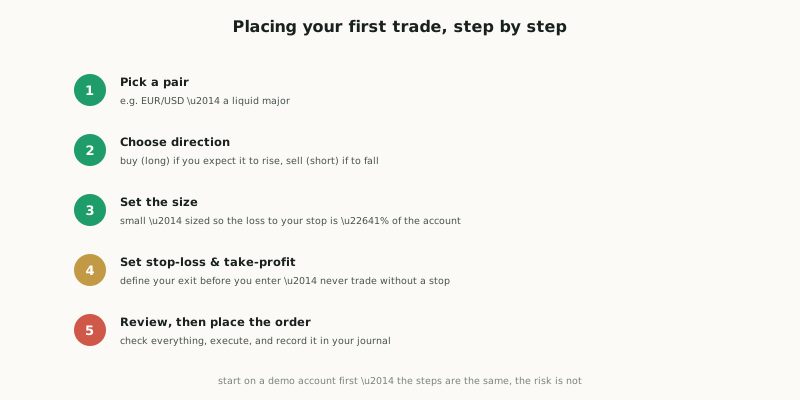
The five steps
Placing a trade breaks down into a simple, repeatable sequence. The key is that the safety decisions — size and stop — are part of the process from the very start, not an afterthought.
Your first trade, step by step
Step one — pick a pair. Choose what to trade. For a first trade, a liquid major such as EUR/USD is ideal: tight spreads (low cost), deep liquidity (clean fills), and abundant information. Step two — choose direction. Decide whether you expect the pair to rise or fall: buy/go long if you expect the price to rise, sell/go short if you expect it to fall. (In forex you can profit from a falling market just as easily as a rising one — selling first, buying back lower.) Step three — set the size. Decide how much to trade. This is where beginners go most wrong: start small, ideally micro lots, sized so that if your stop is hit, the loss is a tiny fraction of your account (see the 1% rule and position sizing). Step four — set the stop-loss and take-profit. Define your exits before you enter: a stop-loss that caps your loss if you're wrong (never trade without one), and optionally a take-profit target. Step five — review and place. Check the pair, direction, size and stop are all correct, then place the order (often a market order to enter now, or a pending order to enter at a set price — see order types) — and record it.
Do it on a demo first — and what comes after
The single best piece of advice for your actual first trade is to make it on a demo account. A demo lets you place trades with virtual money, so you can learn the platform and rehearse this exact five-step sequence — finding the order ticket, entering a size, placing the stop, executing — with zero financial risk. The steps are identical to live trading, so it's the safest possible way to make your genuine "first trade," iron out the inevitable fumbles (clicking buy instead of sell, mis-sizing, forgetting the stop) when they cost nothing, and build the muscle memory and confidence to do it calmly with real money later. Spend real time here: place dozens of demo trades until the mechanics are second nature.
When you do move to live trading, keep the size tiny at first — the psychological difference between demo and real money is significant, and small real trades let you adjust to that emotional reality (the nerves, the hesitation) without meaningful risk. A few habits to build in from trade one: always use a stop-loss; always size by risk, not by gut; and always record the trade afterwards — what you did, why, and the outcome — in a journal, which is how you'll actually learn. Resist the powerful temptation to skip the demo, trade big "to make it worthwhile," or trade without a stop because "this one's a sure thing" — these are the classic beginner mistakes that end accounts early. And keep expectations grounded: your first trades are about learning the process, not making money, and most beginners lose at first regardless (see realistic expectations) — which is fine, and survivable, precisely because you started small with a stop. Done this way, placing your first trade is a calm, controlled, almost boring routine — which is exactly what good trading should feel like. The honest framing: place your first trade in five steps — pick a liquid major like EUR/USD, choose buy (long, expecting a rise) or sell (short, expecting a fall), set a small size (loss to your stop ≤1% of the account), set a stop-loss and take-profit before entering (never trade without a stop), then review and place the order, recording it. Crucially, do your genuine first trade on a demo account — same steps, no risk — then start live tiny. Build the habits from trade one: always a stop, always size by risk, always journal. First trades are for learning the process, not profit; start small and survive.
What happens after you place it
Clicking the button isn't the end — and what you do next matters as much as the entry. Once the trade is live, the single most important discipline for a beginner is to let it work: your stop-loss and take-profit are already in place, defining your exits, so the right action is usually no action. Resist the powerful urge to micromanage — to move the stop further away "to give it room" when price approaches it (turning a small planned loss into a bigger one), to close early in a panic the moment it dips, or to stare at every tick as though watching could change the outcome. You made your decisions when you were thinking clearly; now the job is to honour the plan and let the trade reach your stop or target. There are really only three outcomes: price hits your take-profit (a win — the plan worked), hits your stop-loss (a controlled loss — exactly the small, pre-defined amount you accepted, nothing more), or you exit per your plan for another reason. In every case, the outcome was bounded by the stop you set, which is the whole point of setting it.
A quick worked example ties it together. Say you go long EUR/USD at 1.0850 with a 30-pip stop at 1.0820 and a 60-pip target at 1.0910, sized so the 30-pip loss equals 1% of your account. From there, you simply wait: if price climbs to 1.0910, you bank a win worth twice your risk; if it falls to 1.0820, you take the 1% loss and move on, unbothered, because that was always the plan. Either way, you then do the most valuable thing of all — record it in your journal: what you traded, why, your entry, stop, target and size, and the outcome. Reviewing your trades is how you actually learn, and judging each one on whether you followed your process (not merely whether it won) is what turns a string of first trades into genuine skill. Above all, keep your emotions in proportion: a single trade — win or lose — is just one outcome in a long series, and treating it as neither a triumph nor a disaster is the mindset that lasts. The honest reminder: after you place the trade, let your stop and target do their job — don't tinker, panic-close or move stops; accept whichever bounded outcome arrives, record it in your journal, and judge yourself on following the process, keeping any single result in proportion.
Place your first trade in five steps: (1) pick a pair — a liquid major like EUR/USD; (2) choose direction — buy/long for a rise, sell/short for a fall; (3) set a small size — so the loss to your stop is ≤1% of the account; (4) set a stop-loss and take-profit — define your exits before you enter, and never trade without a stop; (5) review and place the order, then record it. Do your genuine first trade on a demo account (same steps, no risk), then go live tiny. Build three habits from trade one: always a stop, always size by risk, always journal. Your first trades are for learning the process, not making money — most beginners lose early, which is survivable precisely because you started small. Calm and boring is the goal.