The RSI is one of the most popular indicators in trading — and one of the most misused. Beyond the naive "sell when overbought" reflex (which loses money in trends), there are three distinct ways to build strategies around it, each suited to different conditions. The key isn't the indicator itself but knowing which approach to use, and when. This guide explains RSI trading strategies: the three main methods, when each works and fails, and why RSI is a tool, not a signal.
It builds on the RSI indicator itself, connects to divergence and divergence strategies, and spans the mean-reversion vs momentum divide.
Key takeaways
Q: What are the main RSI trading strategies?
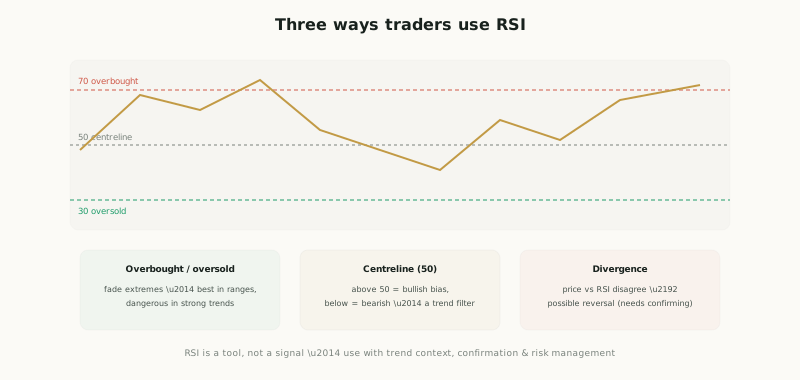
A: There are three principal approaches: (1) overbought/oversold — looking to fade extremes when RSI rises above 70 or falls below 30; (2) the centreline — using the 50 level as a trend filter, with RSI above 50 signalling bullish bias and below 50 bearish; and (3) divergence — spotting when price and RSI disagree (price makes a new high but RSI doesn't), hinting at a possible reversal. Each suits different market conditions.
Q: Is the overbought/oversold RSI strategy reliable?
A: Only in the right conditions. Fading overbought/oversold readings works reasonably well in range-bound markets, where price oscillates between extremes. But it's dangerous in strong trends — in a powerful uptrend, RSI can stay 'overbought' for a long time while price keeps climbing, so naively selling every overbought reading means repeatedly fighting the trend. Overbought is not a sell signal by itself; context is everything.
Q: Why is RSI called a tool, not a signal?
A: Because no single RSI reading reliably tells you to buy or sell on its own. RSI describes momentum conditions, but its meaning depends entirely on context — the trend, the market regime, and confirmation from price action. Used mechanically ('RSI hit 70, sell'), it generates many false signals; used as one input alongside trend context, structure and confirmation, with proper risk management, it's genuinely useful. The trader supplies the judgement.
The three main approaches
The RSI (Relative Strength Index) is a momentum oscillator scaled 0–100, and traders build three principal strategies around it:
| Approach | How it's used | Works best / fails when |
|---|---|---|
| Overbought / oversold | Fade extremes: RSI >70 (sell), <30 (buy) | Best in ranges; fails (stays extreme) in strong trends |
| Centreline (50) | Trend filter: >50 bullish bias, <50 bearish | Best in trends; choppy/whippy in ranges |
| Divergence | Price vs RSI disagree → possible reversal | Useful warning; unreliable alone, needs confirmation |
The overbought/oversold approach is the most famous: when RSI rises above 70 the market is "overbought" (look to sell/fade), and below 30 it's "oversold" (look to buy) — a mean-reversion bet that stretched readings revert. The centreline approach uses the 50 level as a trend filter: RSI above 50 signals bullish momentum/bias, below 50 bearish — a trend-following use that keeps you on the right side of momentum rather than fading it. The divergence approach watches for price and RSI to disagree — e.g. price makes a new high but RSI makes a lower high (bearish divergence), hinting the move is losing momentum and may reverse (see divergence and divergence strategies). Crucially, these approaches suit different conditions — and even contradict each other (overbought/oversold fades moves, the centreline follows them) — which is exactly why blindly applying one regardless of context fails.
Why context is everything
The single most important lesson is that the overbought/oversold reflex is conditional, not universal. It works reasonably well in range-bound markets, where price oscillates between extremes and reverts — fading RSI>70 and buying RSI<30 at the edges of a range can be a sound range tactic. But it's dangerous in strong trends: in a powerful uptrend, RSI can stay "overbought" (above 70) for a long time while price keeps climbing, so naively selling every overbought reading means repeatedly fighting the trend and absorbing losses (the same counter-trend danger as fading). "Overbought" does not mean "about to fall" — it means "strong," which in a trend is a reason to stay long, not to short. This is precisely where the centreline approach is more appropriate: in a trending market, using 50 as a filter (and trading with the side RSI favours) aligns you with momentum instead of against it. So the regime dictates the method: range → fade extremes; trend → use the centreline / trade with momentum. Applying the wrong one for the conditions is the most common RSI mistake.
This is what it means to say RSI is a tool, not a signal. No single RSI reading reliably tells you to buy or sell on its own — the indicator describes momentum conditions, but its meaning depends entirely on context: the trend, the market regime (ranging vs trending), and confirmation from price action and structure. Used mechanically ("RSI hit 70, sell"), it generates a flood of false signals (especially in trends); used as one input alongside trend context, structure and confirmation — and with proper risk management — it's genuinely useful. The practical synthesis: first identify the regime (trending or ranging), then select the appropriate RSI approach for it; treat overbought/oversold as a fade tool only at the edges of ranges (or, at most, as a caution flag in trends, never an automatic reversal trade); use the centreline to stay aligned with trends; treat divergence as an early warning that needs confirmation (a reversal signal in price) before acting, since divergence alone can persist for a long time; and combine RSI with other evidence rather than trading it in isolation. As with every indicator on this site, RSI is no holy grail — it's a useful lens on momentum whose value comes entirely from the judgement the trader brings to it. The honest framing: there are three RSI strategies — overbought/oversold (fade extremes, best in ranges, dangerous in trends where RSI stays extreme), the 50 centreline (trend filter, above=bullish/below=bearish, best in trends), and divergence (price vs RSI disagree, a possible-reversal warning needing confirmation). They suit different regimes and even contradict each other, so match the method to the conditions. RSI is a tool, not a signal: no reading means buy/sell alone — its meaning depends on trend, regime and confirmation, so use it as one input with risk management, not mechanically.
Building a complete RSI approach
The three uses become genuinely powerful when combined into a coherent method rather than applied in isolation. The logical sequence is regime first, RSI second: begin by reading whether the market is trending or ranging (using market structure, higher-timeframe trend, or a tool like an ADX), and only then select the appropriate RSI use — the centreline and pullback approach in a trend, the overbought/oversold fade in a range. This single discipline — letting the regime dictate the RSI method — eliminates the most common and costly RSI error (fading overbought readings in a strong trend). Layer in price structure: RSI signals are far more reliable when they coincide with meaningful levels — an oversold RSI at established support in a range, or a bullish-divergence RSI at a key level, is a much higher-quality setup than the RSI reading alone. And use RSI across timeframes for context (the higher-timeframe RSI for bias, the lower for timing), which keeps you aligned with the dominant momentum.
A few practical settings notes round it out. The default period is 14, which suits most uses; shortening it makes RSI more sensitive (more signals, more noise), lengthening it smooths it — but resist the urge to over-optimise the period or the overbought/oversold thresholds to fit past data, which is just curve-fitting a tool that was never meant to be a precise trigger (some trend traders do sensibly shift the bands — e.g. using 40 as support in an uptrend rather than 30 — to reflect that RSI behaves differently in trends, which is adaptation to regime, not over-fitting). The worked logic of a disciplined RSI trade, then, looks like this: identify the regime; choose the matching RSI approach; wait for the RSI condition to align with price structure and a confirmation (a reversal candle, a level holding, a break); enter with a defined stop; and manage with proper risk control — with RSI serving as one confirming input, never the sole reason for the trade. Treated this way, RSI stops being the misused "sell at 70" reflex and becomes a genuinely useful momentum lens within a complete, context-aware method. The honest reminder: build a complete RSI approach by reading the regime first (trend vs range) and only then choosing the matching RSI use, combining it with price structure and key levels, and using multiple timeframes for context; keep the default 14 period, resist over-optimising levels (vs sensibly shifting bands for a trend), and always require confirmation and a defined stop — RSI as one confirming input within a context-aware method, never the sole trigger.
There are three RSI strategies: overbought/oversold (fade RSI>70 / <30 — best in ranges, dangerous in trends where RSI can stay extreme as price runs), the 50 centreline (a trend filter — above 50 bullish, below bearish — best in trends), and divergence (price and RSI disagree → a possible-reversal warning that needs confirmation). They suit different regimes and even contradict each other, so match the method to the conditions (range → fade extremes; trend → use the centreline). Above all, RSI is a tool, not a signal: no reading means "buy" or "sell" on its own — its meaning depends on trend, regime and confirmation — so use it as one input with structure, price action and risk management, never mechanically. No holy grail — the judgement is yours.