
Some of the most reliable reversal signals need only three bars to tell their story: a push in the prevailing trend, a final extreme, then a decisive snap back the other way. The three-bar reversal is a clean, readable price-action setup that marks a swift shift in momentum — and, traded in the right context, it's a genuinely useful entry trigger. This guide explains the three-bar reversal: the role of each bar, how to enter, stop and target it, and why context makes or breaks it.
It sits alongside other price-action triggers like the pin bar and inside bar, and is most powerful at support and resistance.
Key takeaways
Q: What is a three-bar reversal?
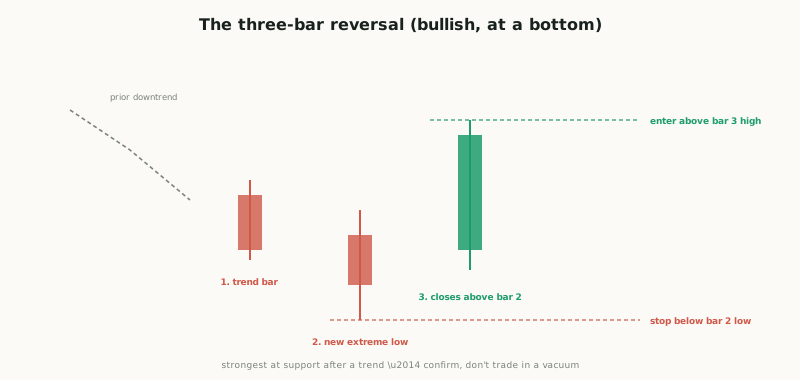
A: A three-bar reversal is a price-action pattern signalling a potential trend change using three consecutive bars (or candles). In a bullish version at a bottom: the first bar continues the downtrend, the second makes a new low (the extreme), and the third reverses sharply and closes above the second bar's high, confirming buyers have taken over. The bearish version mirrors this at a top. It captures a swift shift in momentum.
Q: How do you trade a three-bar reversal?
A: For a bullish reversal, a common approach is to enter on a break above the third bar's high (or at its close), place a stop below the low of the pattern (the second bar's low), and target a sensible level such as a prior structure point or a multiple of the risk. The bearish version is mirrored. Position size by risk, and treat the pattern as a trigger within a wider plan, not a standalone signal.
Q: Is the three-bar reversal reliable?
A: Its reliability depends heavily on context. A three-bar reversal forming at a significant support or resistance level, after an extended trend, or with other confluence is far more meaningful than one appearing randomly in the middle of a range. On its own it's just three bars; combined with location, trend context and confirmation, it becomes a useful, well-defined entry trigger. Like all patterns, it fails sometimes and needs risk management.
The structure
The pattern is defined by three consecutive bars (or candles) that together capture a momentum flip. Taking the bullish version at a market bottom:
The bullish three-bar reversal
The story the three bars tell is a shift of control. Bar 1 continues the prevailing downtrend — sellers still in charge. Bar 2 pushes to a new low, the extreme of the move — often a final flush of selling or an exhaustion spike. Then bar 3 reverses sharply and closes above bar 2's high, demonstrating that buyers have decisively taken over — the new low was rejected and price has snapped back up. That third, confirming bar is the heart of the pattern: it's the evidence that the trend may be turning, not just pausing. The bearish version simply mirrors this at a top: bar 1 continues an uptrend, bar 2 makes a new high, and bar 3 reverses down to close below bar 2's low, showing sellers seizing control. The pattern's appeal is its clarity — it's objective, easy to spot, and captures a real, visible change in momentum in just three bars.
How to trade it — and why context decides
Trading the pattern is straightforward once you see it. For the bullish reversal: enter on a break above the third bar's high (some traders enter at the third bar's close, others wait for the break of its high for extra confirmation); place a stop below the low of the pattern (bar 2's low — the point at which the reversal is clearly invalidated); and set a target at a sensible level such as a prior structure point, a resistance level, or a multiple of your risk (a risk-reward target). Always size by risk so the distance to your stop equals a small, fixed fraction of your account. The bearish version mirrors all of this. The setup gives you a clean, well-defined entry, stop and risk — one of its real virtues.
But here is the crucial point that separates a useful signal from a coin-flip: the three-bar reversal's reliability depends heavily on context. In isolation, three bars are just three bars — the pattern appears constantly across any chart, and most occurrences mean little. What transforms it into a meaningful signal is location and confluence. A three-bar reversal forming at a significant support or resistance level, at the end of an extended trend (where a reversal is plausible), or alongside other evidence (a divergence, a key Fibonacci level, a higher-timeframe turning point, a liquidity sweep) is far more likely to mark a genuine reversal than one appearing randomly mid-range. So the skill isn't spotting the pattern — that's easy — it's spotting it in the right place. The disciplined trader uses the three-bar reversal as a trigger that fires only when price has reached a location where they were already looking for a reversal: the level provides the thesis, the pattern provides the timing and a clean entry. As with every setup on this site, it is not magic — it fails regularly (a "reversal" that resumes the trend is common), it works better in some conditions than others, and it's only as good as the context and the risk management around it. Treat it as one well-defined tool in a price-action toolkit, demand quality context before acting, confirm rather than anticipate, and always trade it with a defined stop and sensible sizing. The honest framing: a three-bar reversal signals a momentum flip in three bars — bullish at a bottom: bar 1 continues the downtrend, bar 2 makes a new low, bar 3 reverses to close above bar 2's high (bearish mirrors at a top). Enter on the break of bar 3's high, stop below the pattern low, target structure or a risk multiple, sized by risk. Its reliability depends on context: powerful at significant support/resistance, after an extended trend, or with confluence; near-meaningless mid-range. Use it as a timing trigger where you already expect a reversal, confirm don't anticipate, and manage risk — it's a clean tool, not a guarantee.
Refinements and common mistakes
A few refinements separate high-quality three-bar reversals from weak ones. The character of the third (confirming) bar matters most: the strongest signals have a large, decisive third bar that closes well beyond bar 2's high (for a bullish reversal) on a strong close near its high — weak confirmation (a small third bar that barely closes above bar 2) is far less convincing and more likely to fail. Volume (where available, bearing in mind forex's tick-volume caveat) adds confidence if the reversal bar shows expanded activity. The extreme of bar 2 ideally coincides with a meaningful level — a known support, a round number, a prior swing — so the reversal has a reason beyond the three-bar shape itself. And the entry choice involves a trade-off: entering at bar 3's close gets a better price but less confirmation; waiting for a break of bar 3's high confirms momentum continues but gives up some entry; many prefer the break for the extra evidence, accepting the slightly worse fill.
The common mistakes are predictable and worth avoiding. The biggest is trading the pattern in a vacuum — spotting three bars mid-range, with no significant level or trend context, and treating it as a signal; these random occurrences are mostly noise, and acting on them is a fast route to a low win rate. Closely related is over-eagerness: forcing the pattern by loosening its definition (calling a sloppy three bars a "reversal") or anticipating it before bar 3 confirms — patience for a clean, confirmed pattern at a good location is the discipline. Another is ignoring the trend context: a bullish reversal against a powerful, intact downtrend is fighting the current and lower-probability than one at a level where the trend is genuinely exhausting. And the universal one: no stop or poor sizing — because the pattern will fail regularly (a "reversal" that resumes the prior trend is common), the stop below the pattern low and proper position sizing are what keep those inevitable failures harmless. Treat the three-bar reversal as a quality-over-quantity setup: wait for the clean pattern, at the right place, with a strong confirming bar, then execute with a defined stop — far better than trading every rough three-bar shape you see. The honest reminder: favour a large, decisive third bar closing well beyond bar 2 at a meaningful level; choose your entry (close vs break) deliberately; and avoid the classic mistakes — trading it in a vacuum, forcing or anticipating the pattern, fighting a strong trend, or skipping the stop — by demanding quality context and always sizing by risk.
A three-bar reversal signals a momentum flip in three bars. Bullish (at a bottom): bar 1 continues the downtrend, bar 2 makes a new low (the extreme), bar 3 reverses to close above bar 2's high (buyers take over); the bearish version mirrors at a top. Enter on the break of bar 3's high, stop below the pattern low (bar 2's low), target a structure level or risk multiple, always sized by risk. Crucially, its reliability is all about context: it's powerful at a significant support/resistance level, after an extended trend, or with confluence — and near-meaningless appearing randomly mid-range. Use it as a timing trigger where you already expect a reversal (level = thesis, pattern = timing), confirm rather than anticipate, and trade it with a defined stop and sensible sizing — it's a clean tool, not a guarantee.