
Most beginners start with the dollar pairs, but a huge part of the market trades "crosses" — pairs that don't involve the US dollar at all. Understanding what they are, how they differ from the majors, and when to use them rounds out your grasp of the currency map and unlocks ways to express views the dollar pairs can't. This guide explains cross currency pairs: what they are, why they exist, their characteristics, and when to choose one.
They sit between the major pairs and the exotics in the currency taxonomy, build on how pairs work, and their behaviour ties to correlations and volatility.
Key takeaways
Q: What is a cross currency pair?
A: A cross currency pair (a 'cross') is any pair that doesn't include the US dollar — for example EUR/GBP, EUR/JPY, GBP/JPY or AUD/NZD. The name comes from the fact that historically, to exchange two non-dollar currencies you'd 'cross' through the dollar (converting one to USD and USD to the other). Today they trade directly, but the term stuck for any non-USD pair.
Q: How do crosses differ from the major pairs?
A: The majors all involve the US dollar (EUR/USD, USD/JPY, etc.) and are the most traded and most liquid pairs. Crosses leave the dollar out, so they isolate a view between two non-dollar currencies. Practically, crosses often have slightly wider spreads and thinner liquidity than the big dollar majors, and some (especially yen crosses) can be more volatile. They're 'minor' pairs — still widely traded, just less than the dollar majors.
Q: When should you trade a cross instead of a dollar pair?
A: When your view is genuinely about those two currencies rather than the dollar. If you think the euro will strengthen against the pound specifically, EUR/GBP expresses that cleanly, without the US dollar's moves muddying the trade. Crosses are also useful for isolating relative strength between, say, two commodity currencies (AUD/NZD), and the yen crosses serve as risk-sentiment barometers. Just account for their sometimes wider spreads and higher volatility.
What they are, and why
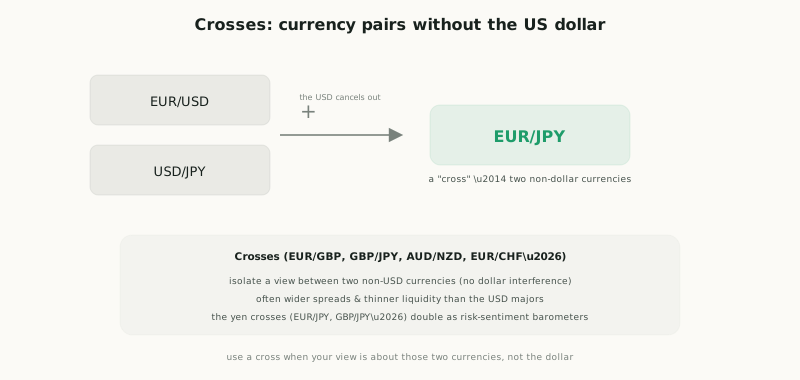
A cross currency pair (a "cross") is any pair that doesn't include the US dollar — for example EUR/GBP, EUR/JPY, GBP/JPY or AUD/NZD. The name has a nice historical origin: to exchange two non-dollar currencies, you'd traditionally have to "cross" through the dollar — converting the first currency to USD, then USD to the second — because the dollar was (and is) the central hub of the currency system. Today these pairs trade directly (no actual dollar conversion needed), but the term "cross" stuck for any non-USD pair. Conceptually, a cross is still "made from" two dollar pairs with the dollar cancelling out: EUR/JPY, for instance, reflects EUR/USD combined with USD/JPY, the USD netting away to leave the pure euro-vs-yen relationship. This is why a cross's behaviour is tied to its two underlying dollar pairs — and why understanding the dollar's role helps you read a cross.
Cross currency pairs at a glance
How they differ, and when to use them
How do crosses differ from the majors? The majors all involve the US dollar (EUR/USD, USD/JPY, GBP/USD, etc.) and are the most traded and most liquid pairs in the world. Crosses leave the dollar out, so they isolate a view between two non-dollar currencies. Practically, this means crosses often have slightly wider spreads and thinner liquidity than the big dollar majors (less volume flows through them, so the cost to trade is a touch higher — see trading costs), and some — especially the yen crosses like GBP/JPY — can be more volatile (combining the swings of two pairs). They're the "minor" pairs in the standard taxonomy: still widely traded and perfectly tradeable, just less liquid than the dollar majors and more liquid than the exotics. None of this makes them inferior — they're an essential part of the toolkit — but it does mean accounting for the slightly higher costs and, in some cases, larger volatility when sizing.
So when should you trade a cross instead of a dollar pair? The clean answer: when your view is genuinely about those two currencies rather than the dollar. If you think the euro will strengthen against the pound specifically, EUR/GBP expresses that cleanly — whereas trading it via EUR/USD and GBP/USD would drag the dollar's own moves into your trade, muddying a view that was never about the dollar. This is the core value of crosses: they let you isolate a relationship and remove the dollar as a confounding variable. They're also ideal for relative-strength plays between two similar currencies — AUD/NZD isolates the two Australasian commodity currencies against each other (stripping out the shared "risk-on" story to leave their differences), and EUR/GBP isolates two intertwined European economies. And the yen crosses (EUR/JPY, GBP/JPY, AUD/JPY) serve as useful risk-sentiment barometers, since they pair a risk currency against the safe-haven yen. The practical discipline: match the pair to your actual view — reach for a cross when the trade is about those two currencies and you want the dollar out of the way, reach for a dollar major when the dollar is part of your thesis (or when you simply want the tightest spreads and deepest liquidity) — while accounting for crosses' sometimes wider spreads and higher volatility. The honest framing: a cross is any pair without the US dollar (EUR/GBP, EUR/JPY, GBP/JPY, AUD/NZD), historically "crossed" through the dollar but now traded directly, and conceptually built from two dollar pairs with the USD cancelling out. Versus the dollar majors, crosses isolate a view between two non-dollar currencies but often carry wider spreads, thinner liquidity and (for yen crosses) more volatility. Use a cross when your view is about those two currencies, not the dollar — to express relative strength cleanly without dollar interference — just sizing for their costs and volatility.
Trading crosses well
Because a cross is conceptually built from two dollar pairs, the single most useful habit when trading one is to watch both underlying pairs. EUR/JPY, for instance, is driven by both EUR/USD and USD/JPY — so a move in the cross can come from euro strength, yen weakness, or both, and checking the two dollar pairs tells you what's really driving it. This matters because sometimes a cross's move is really a dollar move in disguise: if the dollar is broadly strong, it can push the two underlying pairs in ways that move the cross even when nothing has changed between the two non-dollar currencies themselves. Reading the underlying pairs keeps you from misattributing a dollar-driven wobble to a genuine euro-vs-yen shift.
A few further practicalities sharpen cross trading. Mind the cost: crosses' typically wider spreads and thinner liquidity mean execution can be a touch worse, especially in the less-traded crosses and outside the relevant sessions, so factor that in and prefer trading a cross during its currencies' active hours. Use the right cross for the right view: the yen crosses (EUR/JPY, GBP/JPY, AUD/JPY) are excellent risk-on/risk-off barometers (risk currency vs the safe-haven yen), the EUR crosses (EUR/GBP, EUR/CHF) isolate relative European strength, and AUD/NZD isolates the two Australasian commodity currencies. And understand that crosses are kept arithmetically consistent with their underlying dollar pairs (arbitrage keeps EUR/JPY in line with EUR/USD × USD/JPY), so they can't drift independently — which is also why their correlations with the dollar pairs are strong and worth tracking. The disciplined approach: pick a cross when your view is about those two currencies, watch the underlying dollar pairs to understand what's driving it, trade it during the right sessions, and size for its spread and volatility. The honest reminder: trade a cross by watching its two underlying dollar pairs (a cross moves on both, and a cross's move can be a dollar move in disguise), minding its wider spreads and thinner liquidity (prefer the right sessions), and choosing the right cross for your view (yen crosses for risk sentiment, EUR crosses for European strength, AUD/NZD for the Australasian pair) — remembering arbitrage keeps crosses consistent with the dollar pairs they're built from.
Once you start thinking in crosses, the currency market stops looking like a list of isolated pairs and starts looking like a web of relationships — every currency measured against every other, with the dollar as just one hub among several. That mental shift is genuinely useful: it lets you ask "which currency is strong, and against what?" rather than only "what's the dollar doing?", opening up cleaner ways to express almost any view. The dollar pairs are where you start; the crosses are where the map gets interesting.
Master the dollar majors first, then add crosses as your view sharpens — they reward a trader who has learned to think about relative strength rather than just "up or down against the dollar."
A cross currency pair is any pair without the US dollar (EUR/GBP, EUR/JPY, GBP/JPY, AUD/NZD) — historically "crossed" through the dollar, now traded directly, and conceptually built from two dollar pairs with the USD cancelling out. Versus the dollar majors, crosses isolate a view between two non-dollar currencies but often carry wider spreads, thinner liquidity and (for yen crosses) more volatility — they're the "minor" pairs, between majors and exotics. Use a cross when your view is about those two currencies, not the dollar — to express relative strength cleanly without dollar interference (e.g. AUD/NZD for the two Australasian currencies) — and the yen crosses double as risk-sentiment barometers. Match the pair to your actual view, sizing for the costs and volatility.