Spend any time around forex traders or market commentary and you'll hear talk of "cable," "the loonie," "fibre" and "guppy." These aren't obscure jargon to be intimidated by — they're the market's friendly shorthand for the major pairs and currencies, each with a story behind it. Learn them and the chatter suddenly makes sense, and you can follow analysis and conversation without missing a beat. This guide explains forex pair nicknames: what the common ones mean, where they come from, and why the shorthand exists.
It's a fun companion to the major pairs and the trading glossary, and helps decode talk about crosses too.
Key takeaways
Q: What does 'cable' mean in forex?
A: 'Cable' is the nickname for the GBP/USD pair. It dates back to the 19th century, when the GBP/USD exchange rate was transmitted between London and New York via a transatlantic telegraph cable laid under the Atlantic Ocean. The name stuck, and traders still call GBP/USD 'cable' today — one of the oldest and most charming pieces of market shorthand.
Q: What are the main forex pair nicknames?
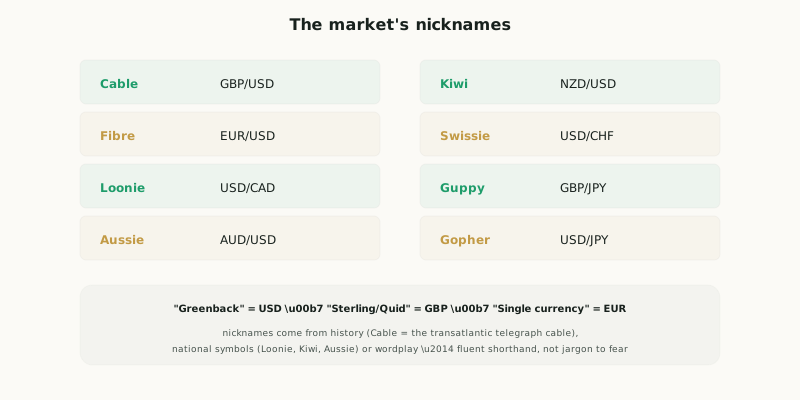
A: Common ones include: cable (GBP/USD), fibre (EUR/USD), loonie (USD/CAD), aussie (AUD/USD), kiwi (NZD/USD), swissie (USD/CHF), guppy (GBP/JPY) and gopher (USD/JPY). Currencies themselves have nicknames too — 'greenback' or 'buck' for the US dollar, 'sterling' or 'quid' for the pound, and 'single currency' for the euro. They're widely used in commentary and among traders.
Q: Why do forex pairs have nicknames?
A: They arise from history (cable from the telegraph cable), national symbols (loonie from the loon bird on Canada's dollar coin; kiwi from New Zealand's bird and coin; aussie for Australia), and wordplay (fibre as a modern nod to cable, since fibre-optic lines succeeded the telegraph; guppy as a playful contraction of GBP/JPY). They're efficient shorthand that makes fast-moving conversation quicker — fluent market language, not jargon designed to exclude.
The main nicknames
Here are the nicknames you'll hear most often, mapping the playful name to the actual pair:
| Nickname | Pair | Where it comes from |
|---|---|---|
| Cable | GBP/USD | The 19th-century transatlantic telegraph cable |
| Fibre | EUR/USD | A modern nod to "cable" (fibre-optic succeeded telegraph) |
| Loonie | USD/CAD | The loon bird on Canada's dollar coin |
| Aussie | AUD/USD | Australia |
| Kiwi | NZD/USD | New Zealand's bird (on its dollar coin) |
| Swissie | USD/CHF | Switzerland / the Swiss franc |
| Guppy | GBP/JPY | Playful contraction of "GBP/JPY" |
| Gopher | USD/JPY | Wordplay on the pair's letters |
"Cable" is the nickname for GBP/USD, and it's the most storied: it dates to the 19th century, when the GBP/USD exchange rate was transmitted between London and New York via a transatlantic telegraph cable laid under the Atlantic Ocean. The name stuck, and traders still call GBP/USD "cable" today. Beyond pairs, the currencies themselves have nicknames: the US dollar is the "greenback" (from the green ink on old US banknotes) or simply the "buck"; the British pound is "sterling" or, colloquially, the "quid"; and the euro is sometimes called the "single currency" (since it's the shared currency of the eurozone). You'll see all of these constantly in market commentary ("the greenback strengthened," "sterling fell on the data," "cable broke 1.30").
Where they come from, and why they matter
The nicknames arise from three main sources, and knowing the origin makes them memorable. History: "cable" from the telegraph cable is the classic example — a piece of 19th-century financial infrastructure preserved in modern slang. National symbols: the "loonie" comes from the loon (a bird) depicted on Canada's one-dollar coin; the "kiwi" from New Zealand's kiwi bird (also on its dollar coin); and the "aussie" simply from Australia — these tie the currency to a recognisable emblem of its country. Wordplay: "fibre" is a witty modern nod to "cable" (since fibre-optic lines succeeded the old telegraph cable for transatlantic communication, EUR/USD — a newer major than GBP/USD — got the updated name); "guppy" is a playful contraction of G-B-P/J-P-Y (and a guppy is a small fish, fittingly memorable); and "gopher" plays on the letters of USD/JPY. There's genuine charm and wit in the lexicon — it reflects a trading culture with a sense of humour and a long history.
So why do they matter to you as a trader? Purely practically, they're efficient shorthand that makes fast-moving conversation and commentary quicker — it's faster to say "cable" than "the British pound against the US dollar," and in a fast market or a busy newsroom, that speed counts. More importantly for a beginner, understanding the nicknames lets you follow trading commentary, analysis and conversation without getting lost: financial news, broker research, trader chat and social media are full of these terms, and a beginner who doesn't know them can feel excluded or misread what's being said ("why is everyone talking about a fish?"). Learning them removes that barrier instantly. The key reassurance is that these are fluent market language, not jargon designed to exclude — they're friendly, often humorous shorthand that traders use as a kind of shared dialect, and once you know them you're simply in on the conversation. You don't need to use them yourself if you'd rather not, but recognising them is a small, easy piece of market literacy that makes everything else — reading analysis, following the news, understanding other traders — smoother. It's one of the quickest ways to feel less like an outsider and more like part of the trading world. The honest framing: forex pair nicknames are the market's friendly shorthand — cable (GBP/USD), fibre (EUR/USD), loonie (USD/CAD), aussie (AUD/USD), kiwi (NZD/USD), swissie (USD/CHF), guppy (GBP/JPY), gopher (USD/JPY) — plus greenback/buck (USD), sterling/quid (GBP) and the single currency (EUR). They come from history (cable = the telegraph cable), national symbols (loonie, kiwi) and wordplay (fibre, guppy). Learning them isn't essential to trade, but it lets you follow commentary and conversation easily — fluent market language, not jargon to fear.
More nicknames, and reading commentary fluently
Beyond the core pairs, you'll meet group nicknames and a few extras worth knowing. The commodity dollars — AUD, CAD and NZD — are collectively the "comdolls" (see commodity currencies), and AUD and NZD together are the "antipodeans" (or just "the Aussie and Kiwi"). The Scandinavian currencies (Norwegian krone, Swedish krona) are the "Scandies." The yen pairs as a group are the "yen crosses," and pairs are bucketed as "majors," "minors" (crosses) and "exotics." The US Dollar Index is "DXY" or, informally, "dixie." You'll also hear "risk-on"/"risk-off" describing market mood, and currency-specific shorthand in news ("the Swissie rallied," "the Loonie slid on oil"). None of these are essential vocabulary, but they recur constantly in commentary.
The real payoff is being able to read commentary fluently. Once the nicknames click, a sentence like "the greenback firmed, dragging cable lower while the yen crosses caught a risk-off bid" instantly parses as: the US dollar strengthened, pushing GBP/USD down, while the yen-cross pairs fell as the safe-haven yen gained on risk aversion. To a beginner that sentence is gibberish; to someone who knows the shorthand it's a clear, quick read of the market. The trick to fluency is just connecting the nickname to the pair and the implied move: "greenback up" means dollar strength (so dollar pairs move accordingly), "cable broke higher" means GBP/USD rose, "the aussie sold off" means AUD/USD fell, and so on. This literacy lets you absorb fast-moving news, broker research, and trader chat without translation lag — a genuine, if small, edge in keeping up. And it's worth repeating the reassurance: this is shared, often affectionate market culture, not a gate to keep you out — traders use nicknames because they're quick and human, and picking them up makes you feel (and operate) like part of the conversation rather than an outsider squinting at jargon. The honest reminder: beyond the core pairs, know the group nicknames — comdolls (AUD/CAD/NZD), antipodeans (AUD/NZD), Scandies, yen crosses, majors/minors/exotics, and DXY/"dixie" for the dollar index — and use them to read commentary fluently by connecting each nickname to its pair and implied move ("greenback up" = dollar strength), turning market chatter from gibberish into a quick, clear read; it's shared market culture, not a barrier.
If the nicknames feel like a lot to absorb at first, don't worry — you'll pick them up naturally just by reading the news and watching the market, the same way you'd learn the slang of any community by spending time in it. There's no need to memorise a list; encounter "cable" a few times in context and it sticks. Within a few weeks of paying attention, the market's shorthand becomes second nature, and one more small thing that once felt foreign simply becomes part of how you read the market.
Think of them as the friendly first handshake with the trading community — a small, low-stakes bit of fluency that quietly signals you're finding your feet, and makes the whole noisy world of market commentary feel a little more like home.
Forex pair nicknames are the market's friendly shorthand: cable (GBP/USD), fibre (EUR/USD), loonie (USD/CAD), aussie (AUD/USD), kiwi (NZD/USD), swissie (USD/CHF), guppy (GBP/JPY) and gopher (USD/JPY) — plus greenback/buck (USD), sterling/quid (GBP) and the single currency (EUR). They come from history (cable = the 19th-century telegraph cable), national symbols (loonie, kiwi) and wordplay (fibre, guppy). Learning them isn't essential to trade, but it lets you follow commentary and conversation easily — fluent, often witty market language, not jargon designed to exclude. Recognise them and you're simply in on the conversation.