There's no shortage of people promising to teach you forex "fast" — usually for a fee. The honest path is slower, mostly free, and far more reliable: build the fundamentals, practise deliberately on a demo, review your trades, then scale up gradually. Knowing the realistic roadmap — and how to spot the traps that prey on eager beginners — saves you time, money and a lot of disappointment. This guide lays out how to learn forex trading: a structured path, why most of what you need is free, how long it takes, and how to avoid course scams.
It expands on how to start, leans on demo practice, and follows the arc of the trader's learning curve.
Key takeaways
Q: How do you learn forex trading as a beginner?
A: Follow a structured path: first build the fundamentals (how the market works, orders, risk management, the major concepts), then practise on a demo account with no money at risk, keep a journal to review and learn from your trades, move to live trading with very small size, and scale up only gradually as your results justify it. Lean on quality free education, learn deliberately, and accept that genuine competence takes years, not weeks.
Q: Do you need to pay for a forex course?
A: No — most of what a beginner needs is freely available. There's a vast amount of high-quality free education online (including comprehensive guides like this site), broker tutorials, and books. Some paid education can be worthwhile, but the industry is also full of expensive 'get-rich-quick' courses, gurus and signal sellers selling hype rather than real skill. Be deeply sceptical of anyone promising fast, easy riches, and never assume a high price means high quality.
Q: How long does it take to learn forex trading?
A: Far longer than most beginners expect — typically years to become genuinely competent and consistent, not weeks or months. You can learn the basics quickly, but developing a real edge, the discipline to follow it, and sound psychology takes sustained practice and many trades. Anyone suggesting you can master trading in a weekend course is misleading you. Treat it as a serious skill built over time, keep expectations realistic, and protect your capital while you learn.
A realistic roadmap
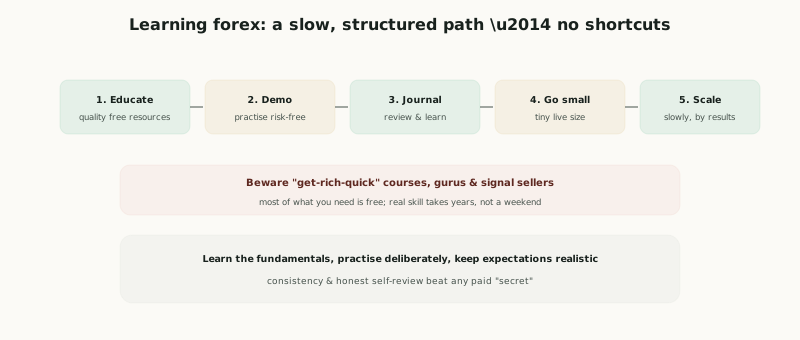
Learning forex as a beginner follows a structured path, and the key insight is that it should be slow, deliberate, and mostly free — the opposite of the fast, paid shortcut the industry sells. First, build the fundamentals: how the market works, orders, risk management (the most important and most neglected), and the major concepts (a structured library like this site covers the lot). Then practise on a demo account with no money at risk — learning the platform and testing ideas where mistakes are free. Keep a journal to review and learn from your trades (the feedback loop that turns experience into skill). Move to live trading with very small size (real money adds emotions a demo can't, so ease in). And scale up only gradually as your results genuinely justify it. Throughout, lean on quality free education, learn deliberately (study with intent, don't just consume), and accept that genuine competence takes years, not weeks. This ordering matters: fundamentals before practice, practice before real money, small before large, results before scaling — each stage earns the next. Rushing the sequence (skipping risk management, skipping the demo, sizing up before you're consistent) is exactly how beginners turn an education into an expensive disaster.
Free over paid, and how long it takes
A crucial, money-saving point: you don't need to pay for a forex course — most of what a beginner needs is freely available. There's a vast amount of high-quality free education online (comprehensive guides, this very site, reputable broker tutorials, and good books), more than enough to learn everything foundational. Some paid education can be worthwhile, but the industry is also full of expensive "get-rich-quick" courses, gurus and signal sellers selling hype rather than real skill — and a great deal of the "education" marketed to beginners is closer to a scam than a genuine course. The guiding rules: be deeply sceptical of anyone promising fast, easy riches (the promise itself is the warning sign — real trading is hard and uncertain, and no honest teacher claims otherwise), and never assume a high price means high quality (expensive courses are often worse value than free resources, trading on the illusion that paying a lot means getting a secret). A useful test: anyone whose pitch leans on lifestyle imagery, guaranteed profits, or urgency is selling a dream, not an education — walk away. The free, patient route is not just cheaper but genuinely more reliable.
Finally, how long does it take? Far longer than most beginners expect — typically years to become genuinely competent and consistent, not weeks or months. You can learn the basics quickly (the mechanics, the terms, how to place a trade), but developing a real edge, the discipline to follow it, and sound psychology takes sustained practice and many trades (and surviving the humbling learning curve). Anyone suggesting you can master trading in a weekend course is misleading you — the timeline alone exposes the get-rich-quick pitch as false. Treat trading as a serious skill built over time, like learning an instrument or a profession: keep expectations realistic, embrace the long timeline rather than fighting it, and — critically — protect your capital while you learn (keep risk tiny early on, so the inevitable beginner losses are cheap tuition, not account-ending). The traders who make it are those who treated learning as a patient, multi-year process, leaned on free quality resources, practised deliberately, and never bet big before they were ready — not those who paid for a "shortcut" that doesn't exist. The honest framing: learn forex via a structured path — build the fundamentals (especially risk management), practise on a demo, journal and review, trade live small, then scale gradually by results — learning slowly and deliberately. You don't need to pay: most of what you need is free, and the industry is full of get-rich-quick courses and gurus selling hype, so be sceptical of fast-riches promises and don't equate price with quality. It takes years, not weeks, to become genuinely competent, so keep expectations realistic and protect your capital while you learn.
What to study, and in what order
Knowing you should "build the fundamentals" is one thing; knowing what to study, in what order, is another. A sensible syllabus runs roughly like this. First, the market basics: what forex is, how pairs work, reading a quote, pips, lots and leverage, and order types — the mechanics you can't trade without. Second, and earlier than most beginners think, risk management: position sizing, stops, and the 1% rule — because this is what keeps you alive long enough to learn everything else, and it's the single most neglected area. Third, analysis: the basics of technical and fundamental analysis, enough to form a view. Fourth, psychology: trading psychology — woven through everything, since managing yourself is most of the game.
Then comes strategy (developing or adopting a method with a tested edge) and, throughout, journaling (the feedback loop that converts screen time into skill). The ordering carries a deliberate message: risk management comes before strategy, not after — a beginner who learns to control risk with a mediocre strategy will outlast one with a brilliant strategy and no risk control. And psychology runs in parallel from the start, because the best plan is worthless if you can't follow it. A well-organised library (like this site's eight pillars) lets you work through this syllabus systematically rather than consuming random tips. The meta-skill is deliberate, structured study: pick a topic, learn it properly, apply it on a demo, review the results, and move on — rather than hopping between disconnected videos hoping something sticks. Learn in this order, lean on quality free material, and you'll build a coherent foundation instead of a pile of fragments. The honest reminder: study in a sensible order — market basics (pairs, quotes, pips/leverage, orders) first, then risk management early (sizing, stops, the 1% rule — it keeps you alive), then technical and fundamental analysis, with psychology woven throughout, and strategy and journaling on top; risk management comes before strategy, and the meta-skill is deliberate structured study (learn a topic, apply it on demo, review, move on) using a well-organised library rather than random tips.
Above all, be patient with yourself: every skilled trader was once a confused beginner, and the ones who made it simply kept learning, kept their risk small, and refused to be rushed by the promise of fast money. Treat learning as the real work — the profits, if they come, follow the competence.
Start today with a single topic, learn it properly, and let the foundation build from there — steady progress compounds.
Learn forex via a structured path: build the fundamentals (especially risk management), practise on a demo, journal and review, trade live small, then scale gradually by results — slowly and deliberately, each stage earning the next. You don't need to pay: most of what you need is free and high-quality, while the industry is full of get-rich-quick courses, gurus and signal sellers selling hype — so be deeply sceptical of fast-riches promises (the promise is the warning sign) and never equate price with quality. It takes years, not weeks, to become genuinely competent (basics are quick; a real edge, discipline and psychology are slow), so keep expectations realistic and protect your capital while you learn — keep risk tiny so early losses are cheap tuition.