GBP/NZD is one of the wildest of the commonly-traded crosses — big daily ranges, wide spreads, and two currencies pulled by very different forces. It can offer real opportunity to those who understand it, but it punishes careless sizing. This guide covers trading GBP/NZD: its character, what drives the pound and the New Zealand dollar, and why it's a pair for experienced hands.
It combines the drivers of GBP/USD and NZD/USD, and sits among the more demanding crosses alongside the exotics.
Key takeaways
Q: What is GBP/NZD?
A: GBP/NZD is the currency pair pricing the British pound (GBP) against the New Zealand dollar (NZD) — how many New Zealand dollars one pound buys. It's a minor cross (it doesn't involve the US dollar), known for being highly volatile with relatively wide spreads and lower liquidity than the majors. It blends the pound's drivers with those of the commodity- and risk-linked Kiwi.
Q: What drives GBP/NZD?
A: Both sides of the relationship. The pound responds to the Bank of England, UK economic data and risk sentiment; the New Zealand dollar responds to the Reserve Bank of New Zealand, soft-commodity prices (notably dairy), global risk appetite and developments in China and Asia-Pacific. Because the two economies and central banks are so different and often out of sync, the cross can move sharply on either side's news, contributing to its volatility.
Q: Is GBP/NZD good for beginners?
A: Generally no. Its high volatility, wide spreads and lower liquidity make it unforgiving — large swings can hit stops fast and the wider spread raises trading costs. It's better suited to experienced traders who understand its character, size positions conservatively to account for the big ranges, and have a clear reason to trade it. Beginners are better served starting with liquid majors like EUR/USD.
The pair at a glance
GBP/NZD snapshot
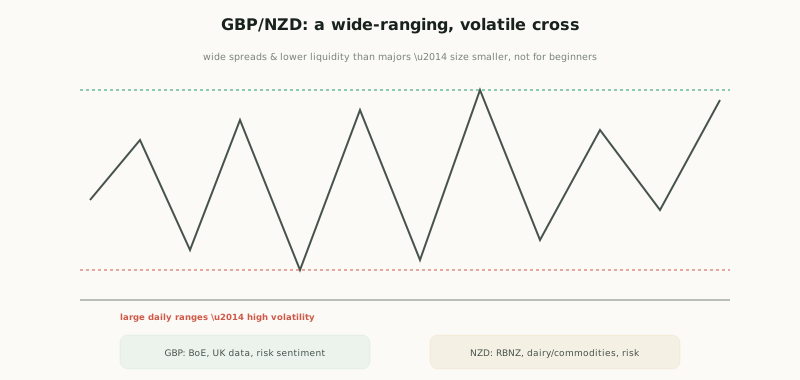
GBP/NZD prices the British pound against the New Zealand dollar — how many New Zealand dollars one pound buys. As a minor cross (no US dollar leg), it carries the typical cross characteristics in a pronounced form: wider spreads and lower liquidity than the majors, and notably high volatility with large daily ranges. That volatility is the pair's defining feature, arising from the combination of the pound's own swings with the Kiwi's commodity- and risk-driven moves, and from the two economies often being out of sync.
What drives it, and how to approach it
GBP/NZD moves on both sides of the relationship. The pound responds to the Bank of England, UK economic data (inflation, growth, employment) and broad risk sentiment. The New Zealand dollar responds to the Reserve Bank of New Zealand, soft-commodity prices (especially dairy, a key NZ export), global risk appetite (NZD is a risk-on currency), and developments in China and the Asia-Pacific region (NZ's major trading partners). Because the two central banks and economies are so different and frequently moving on different schedules — a divergence story — the cross can lurch on news from either side, which is much of why its ranges are so wide. A GBP/NZD view really requires forming a read on both the UK and New Zealand pictures and their relative trajectory.
Approaching this pair means respecting its character. Its high volatility cuts both ways: bigger ranges mean bigger potential moves, but also that stops get hit fast and adverse swings can be severe — so positions must be sized conservatively to account for the large ranges (a given pip stop represents more movement risk here than on a placid major, and under the 1% rule the wide stops a volatile cross needs translate into smaller positions). The wider spread also raises trading costs, eating more of each trade's edge. On timing, the pair is influenced by both the London session (driving the pound) and the Asia-Pacific hours (driving the Kiwi), so liquidity and activity vary through the day; many find the London session, when GBP is most active, the more tradeable window, while being mindful of NZD-driven moves during Asian hours. Honestly, GBP/NZD is not a beginner's pair: its volatility, spreads and lower liquidity make it unforgiving, and newcomers are far better served by liquid majors like EUR/USD. For experienced traders who understand its personality, have a clear thesis on the UK-vs-NZ picture, size for the big ranges, and apply strict risk management, it can offer genuine opportunity — but always with full respect for how quickly and far it can move. As with every pair, it has no magic edge of its own; the edge is in understanding it and managing the risk. The honest framing: GBP/NZD prices the pound against the New Zealand dollar — a volatile minor cross with wide ranges, wider spreads and lower liquidity than majors. It's driven by both sides: GBP by the BoE, UK data and risk; NZD by the RBNZ, dairy/commodities, risk appetite and China/Asia — the two often out of sync, fuelling the volatility. Respect its character: size conservatively for the big ranges, mind the wider spread's cost, and trade it around the relevant sessions. Not a beginner's pair; for experienced traders with a clear UK-vs-NZ view and strict risk management.
Trading approach and what to watch
Because GBP/NZD is driven by two often-divergent economies, it tends to trend well when the UK and New Zealand stories pull apart — which makes a trend-following, higher-timeframe approach a natural fit, riding the medium-term moves that emerge from policy and growth divergence between the BoE and RBNZ. The flip side is that the pair's volatility reshapes everything about execution. Stops must be placed wider to survive the large daily ranges (a stop that's fine on EUR/USD would be noise here and get clipped instantly), and — critically — those wider stops mean smaller positions under the 1% rule: the same fixed risk amount divided by a much larger stop distance gives a noticeably smaller position than on a calm major. Traders who forget this and size GBP/NZD like a major routinely take outsized losses when the pair makes one of its characteristic lunges. Patience also matters: the volatility can produce sharp false moves, so waiting for confirmation rather than chasing every spike pays off.
On what to watch, you're tracking both calendars. On the GBP side: Bank of England decisions and guidance, UK inflation, growth and employment data, and the pound's sensitivity to UK political and fiscal news. On the NZD side: Reserve Bank of New Zealand decisions, New Zealand data, dairy prices (the regular dairy auctions can move the Kiwi), broad risk appetite, and China/Asia-Pacific developments. Because either side can jolt the pair, scheduled releases from both countries are potential volatility events worth respecting (consider being flat or smaller into major ones). On correlations, GBP/NZD tends to move with other GBP crosses (like GBP/AUD) and inversely with NZD strength, so holding it alongside related positions can quietly concentrate risk (see currency correlations) — worth checking your aggregate exposure. On sessions, the London session is usually the most tradeable window (GBP at its most active, decent liquidity), while the Asia-Pacific hours bring NZD-driven moves on thinner liquidity — so many prefer London for cleaner conditions while staying alert to overnight Kiwi catalysts. The honest reminder: trade GBP/NZD with a trend-following, higher-timeframe lean (it trends on UK–NZ divergence), but place wider stops and therefore smaller positions for its big ranges; watch both the BoE/UK and RBNZ/NZ calendars (plus dairy, risk mood and China), mind its correlation with other GBP crosses, favour the London session, and respect every release as a potential volatility event.
Where it fits
GBP/NZD is firmly a pair for the experienced and the deliberate. Its big ranges can be genuinely rewarding for traders who want volatility — swing and trend traders who can stomach the swings, size correctly, and capitalise on the sustained moves that UK–NZ divergence produces. But that same volatility, combined with wider spreads and lower liquidity, makes it unforgiving of mistakes: oversize it, place stops too tight, or trade it without a clear thesis, and the pair's lunges will find you quickly. It's one of the clearer examples of why matching the pair to your experience and risk tolerance matters — a calm trader who values steady conditions will find GBP/NZD stressful, while a volatility-comfortable trader with strict discipline may find opportunity in it. Beginners, almost without exception, should leave it alone and build their skills on liquid, better-behaved majors first.
The synthesis: treat GBP/NZD as a higher-volatility, trend-prone cross driven by the relative UK-versus-NZ story; form a genuine view on both economies and their central banks, size down to respect the ranges (wide stops, small positions), favour the London session for cleaner conditions, respect both calendars as volatility events, and never confuse its big moves for easy money. Done with that discipline, it can be a productive pair for the experienced; done carelessly, its volatility and costs will erode an account fast. The edge is in understanding the two sides and managing the risk — the pair itself offers no shortcut.
GBP/NZD prices the pound against the New Zealand dollar — a volatile minor cross with wide ranges, wider spreads and lower liquidity than the majors. It's driven by both legs: GBP by the Bank of England, UK data and risk sentiment; NZD by the RBNZ, dairy/commodities, risk appetite and China/Asia — the two economies often out of sync, which fuels the volatility. Respect its character: size conservatively for the big ranges (wide stops → smaller positions under the 1% rule), mind the wider spread's cost, and trade it around the relevant sessions (London for GBP). Not a beginner's pair — it's for experienced traders with a clear UK-vs-NZ view and strict risk management.