Most central-bank tools target the price of money — the short-term interest rate. Yield curve control goes further, pinning a longer-term bond yield to a chosen target and buying whatever it takes to hold it there. It's a powerful, unusual policy with notable currency effects, and the Bank of Japan wrote the textbook on both its mechanics and its pitfalls. This guide explains yield curve control: what it is, how it differs from QE, its effect on the currency, and the lessons from Japan.
It belongs in the unconventional-policy family with QE and QT, operates on bond yields, and reshapes the yield curve itself.
Key takeaways
Q: What is yield curve control?
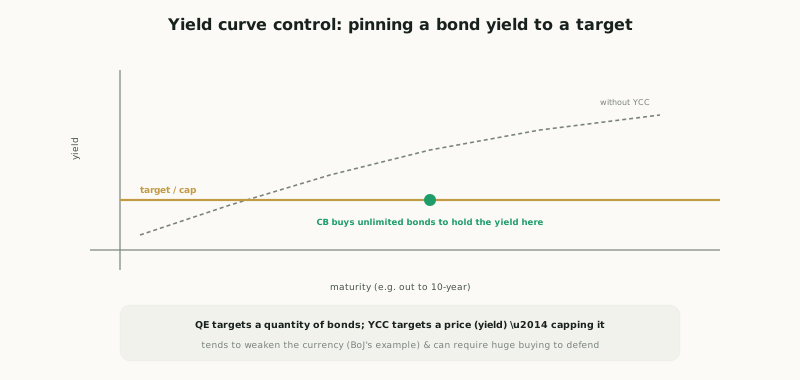
A: Yield curve control (YCC) is a monetary policy where a central bank targets a specific level for a particular bond yield — say, the 10-year government bond at around 0% — and commits to buying whatever quantity of bonds is needed to keep the yield at or below that target. Instead of setting a quantity of purchases (as in QE), it sets a price (the yield) and lets the quantity adjust. It's an unconventional tool to keep longer-term borrowing costs low.
Q: How does yield curve control differ from QE?
A: Quantitative easing targets a quantity — the central bank buys a set amount of bonds, and the resulting yield is whatever the market settles at. Yield curve control targets a price — it fixes the yield and buys whatever quantity is needed to defend it. So QE controls how much it buys; YCC controls where the yield sits. YCC can in theory require unlimited buying to hold the target, whereas QE has a defined size.
Q: How does yield curve control affect the currency?
A: It tends to weaken the currency. By capping yields, YCC keeps the currency's returns low even if inflation or global rates rise — making it less attractive to hold relative to currencies with rising yields, so capital flows away. The Bank of Japan's YCC is the prime example: as other central banks raised rates while the BoJ pinned Japanese yields low, the widening gap drove the yen sharply weaker, and defending the cap required enormous bond buying.
What it is, and how it differs from QE
Yield curve control (YCC) is a monetary policy where a central bank targets a specific level for a particular bond yield — say, the 10-year government bond at around 0% — and commits to buying whatever quantity of bonds is needed to keep that yield at (or below) the target. The defining move is that it sets a price (the yield) and lets the quantity of purchases adjust to defend it, the opposite emphasis from conventional bond-buying. The aim is to keep longer-term borrowing costs low (mortgages, corporate and government borrowing all key off longer yields), providing stimulus further out the curve than a short-term rate cut reaches.
The cleanest way to grasp YCC is to contrast it with quantitative easing:
| Feature | Quantitative easing (QE) | Yield curve control (YCC) |
|---|---|---|
| Targets | A quantity of bonds to buy | A price — a specific yield level |
| What adjusts | The yield (whatever the market settles at) | The quantity bought (whatever it takes) |
| Size | Defined (a set programme size) | Open-ended — potentially unlimited buying |
| Control | Controls how much it buys | Controls where the yield sits |
So QE controls how much the bank buys, and the resulting yield is whatever the market settles at; YCC controls where the yield sits, and buys whatever quantity is needed to defend it. In principle YCC can require unlimited buying to hold the target (if markets push hard against the cap, the bank must keep buying to enforce it), whereas QE has a defined size. They're related cousins — both involve buying bonds to ease policy — but the target differs fundamentally (quantity vs price), and that difference drives YCC's distinctive dynamics.
The currency effect and the Bank of Japan's lessons
For forex, the central question is how YCC affects the currency, and the tendency is clear: it weakens it. By capping yields, YCC keeps the currency's returns low even if inflation or global rates rise — so when other central banks are raising rates and offering rising yields, a YCC currency is pinned at low yields, making it relatively unattractive to hold. Capital flows away toward the higher-yielding alternatives, and the currency weakens — the wider the gap between the capped domestic yield and rising foreign yields, the stronger the downward pressure (a stark version of the central-bank divergence effect). The Bank of Japan is the prime real-world example, and its experience is instructive. The BoJ ran YCC for years, pinning Japanese yields near zero to fight deflation; for a long time this coexisted with a stable yen. But when other central banks raised rates aggressively while the BoJ held Japanese yields low, the widening yield gap drove the yen sharply weaker — a textbook demonstration of how a yield cap, against a backdrop of rising global rates, undermines a currency. The BoJ's YCC also revealed the policy's strains: defending the cap required enormous bond buying (the bank ended up owning a huge share of the market, distorting it), and as market pressure to push yields above the cap built, the BoJ had to repeatedly intervene and eventually adjust and loosen the target — each tweak triggering sharp yen and bond-market reactions, since markets watch a YCC regime obsessively for signs it will be widened or abandoned.
Those strains point to YCC's broader lessons and limits. It can be effective at holding yields down (the bank has, in effect, unlimited firepower in its own currency to buy bonds), but it comes at a cost: it can require massive, market-distorting purchases, it cedes control of the balance-sheet size (you buy whatever it takes, which can be a lot), and exiting is fraught — removing or raising the cap can cause yields to jump and the currency to swing violently, so an entrenched YCC is hard to unwind smoothly. For traders, the practical implications are: a YCC regime is generally currency-weakening when global rates are rising (the yield gap widens against the capped currency); the regime creates asymmetric event risk around any hint of the cap being adjusted (a widening or abandonment can spark a sharp currency rally as suppressed yields are freed); and the policy makes the currency highly sensitive to the global rate backdrop and to the central bank's communication about the regime's future. As with all fundamentals, this explains the forces and risks, not a precise trade — so watch the yield gap, the central bank's signals, and combine with the price action and disciplined risk management. The honest framing: yield curve control pins a chosen bond yield (e.g. the 10-year) at a target, buying whatever quantity it takes to defend it — so where QE targets a quantity (and the yield floats), YCC targets a price (and the quantity floats, potentially unlimited). It tends to weaken the currency by capping yields while others rise, pulling capital away — the Bank of Japan's YCC drove a sharp yen decline as global rates climbed and required massive bond buying to defend, with each adjustment sparking volatility. Watch the yield gap and the bank's signals about the cap; exits are fraught and currency-moving.
Beyond Japan: the wider picture
While the Bank of Japan is the defining modern example, YCC isn't unique to it, and the comparisons are illuminating. Australia's Reserve Bank adopted a form of YCC during the pandemic (targeting a short-dated yield) but was forced to abandon it when market pressure and improving conditions made the target untenable — a sharp lesson in how a yield cap can break when the economics turn against it. Further back, the US Federal Reserve ran a version of yield curve control in the 1940s to keep wartime and post-war borrowing costs low, eventually unwinding it in the early 1950s. The recurring theme across all of these is that pinning a price is easy while markets agree with you and hard when they don't.
That points to the most useful mental model: YCC closely resembles a currency peg, just applied to a bond yield instead of an exchange rate. In both, the authority defends a chosen price with (potentially unlimited) intervention — buying bonds to hold the yield, or buying/selling currency to hold the peg (see intervention and exchange-rate regimes). And in both, credibility is everything: as long as markets believe the cap will hold, little intervention may be needed; but if markets doubt it (because inflation or global rates argue for higher yields), they push against it, forcing ever-larger buying to defend the line — and if the bank's resolve or capacity wavers, the regime can break, with yields and the currency jumping violently (the same dynamic that breaks currency pegs in a crisis). This gives YCC a binary, regime-like risk that traders position around: the cap holds (status quo, suppressed yields, weak currency) or it breaks/widens (yields jump, currency can rally hard). Much of the trading interest in a YCC currency therefore centres on gauging the probability and timing of the regime cracking. The honest reminder: YCC isn't only Japan — Australia's RBA tried and was forced to abandon it, and the Fed used it in the 1940s; the best model is a currency peg applied to a bond yield, where credibility is everything and the regime can break violently if markets doubt it, creating a binary "holds or breaks" risk (suppressed yields and weak currency vs a yield jump and currency rally) that traders position around.
Yield curve control (YCC) pins a chosen bond yield (e.g. the 10-year) at a target, with the central bank buying whatever quantity it takes to defend it. So where QE targets a quantity (and the yield floats), YCC targets a price (and the quantity floats — potentially unlimited). It tends to weaken the currency by capping yields while others rise, pulling capital away — the Bank of Japan's YCC drove a sharp yen decline as global rates climbed, and required massive bond buying to defend (distorting the market). Watch the yield gap versus other countries and the bank's signals about the cap: any adjustment or exit is fraught and can spark a sharp currency rally as suppressed yields are freed. Currency-weakening under rising global rates; high event risk around the regime — read in context, manage risk.