Many traders weigh up forex against stock indices like the S&P 500 or FTSE 100. Both are hugely popular, both are commonly traded as leveraged CFDs, but they behave quite differently — in what they represent, when they move, and what drives them. Understanding the contrast helps you pick the right arena for your interests and style. This guide compares forex and indices: the key differences, which might suit a beginner, and whether to trade both.
It rounds out the comparison series alongside forex vs stocks and forex vs crypto, and both are usually traded via CFDs.
Key takeaways
Q: What's the difference between forex and indices?
A: Forex is the trading of currency pairs (one currency against another), while an index tracks a basket of stocks — the S&P 500, FTSE 100, Nasdaq 100 and so on. Forex trades 24 hours a day five days a week and is driven by macro factors like interest rates and growth; indices broadly follow their underlying exchange's hours (and gap between sessions) and are driven by corporate earnings, the economy and risk sentiment. Both are commonly traded as leveraged CFDs.
Q: Is forex or indices better for beginners?
A: Neither is automatically better — it depends on your interests and approach. Forex offers round-the-clock access, the deepest liquidity, and a focus on macroeconomics. Indices give exposure to whole stock markets in one instrument, with their own clear sessions and a historic long-term upward drift in major markets. Both carry real risk, especially with leverage. The core principles — risk management, education, only risking what you can afford — matter far more than the choice of market.
Q: Can you trade both forex and indices?
A: Yes — many traders do, often through the same broker and platform, since both are widely offered as CFDs. The same analytical and risk-management skills largely transfer between them. If you trade both, just respect their different characters — indices can gap between sessions and react sharply to earnings and economic news, while forex runs continuously through the week — and size each position appropriately for its own volatility.
How they compare
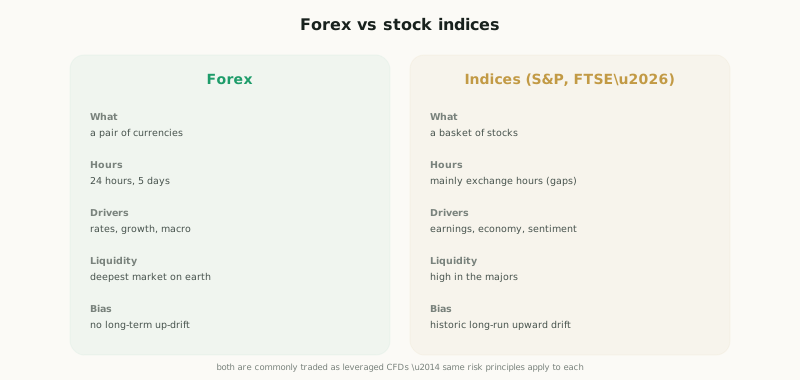
The two markets differ across several dimensions a trader cares about:
| Dimension | Forex | Indices |
|---|---|---|
| What it is | A pair of currencies | A basket of stocks (S&P 500, FTSE 100…) |
| Hours | 24 hours, 5 days | Mainly exchange hours (gaps between) |
| Main drivers | Rates, growth, macro | Earnings, the economy, risk sentiment |
| Liquidity | Deepest market on earth | High in the major indices |
| Long-term bias | No inherent up-drift | Historic long-run upward drift (major markets) |
The core difference is what they are: forex is the trading of currency pairs (one currency against another — see how pairs work), while an index tracks a basket of stocks — the S&P 500, FTSE 100, Nasdaq 100 and so on — giving exposure to a whole stock market in a single instrument. From this flow the other differences. Hours: forex trades 24 hours a day, five days a week (continuously through the week), whereas indices broadly follow their underlying exchange's hours and tend to gap between sessions (the cash index has clear open/close times, though index CFDs/futures often trade extended hours, they still react around the cash session). Drivers: forex is driven by macro factors like interest rates, growth and central-bank policy (see what moves the market), while indices are driven by corporate earnings, the broad economy, and risk sentiment (how optimistic or fearful investors feel). Liquidity: forex majors are the deepest, most liquid instruments anywhere, while major indices are also highly liquid but not on the same scale. And a notable structural difference is long-term bias: major stock indices have a historic long-run upward drift (economies and company earnings have tended to grow over decades), whereas a currency pair has no inherent direction — it's always one currency relative to another, with no built-in tendency to rise over time. Crucially, both are commonly traded as leveraged CFDs, so the same leverage-driven risk applies to each.
Which suits you, and trading both
So is forex or indices better for a beginner? Neither is automatically better — it depends on your interests and approach. Forex offers round-the-clock access (handy if you can only trade certain hours), the deepest liquidity, and a focus on macroeconomics — appealing if you enjoy following central banks and the global economy. Indices give exposure to whole stock markets in one instrument (no need to pick individual shares), with their own clear sessions and that historic long-term upward drift in major markets (which some find more intuitive than forex's directionless, relative nature). Both carry real risk, especially with leverage, and neither is "safer" in any meaningful sense. The most important point echoes the rest of this series: the core principles — risk management, education, only risking what you can afford — matter far more than the choice of market. Pick the arena that genuinely interests you (curiosity sustains the long learning process), and bring sound discipline to it.
And you can absolutely trade both: many traders do, often through the same broker and platform, since both are widely offered as CFDs, and the same analytical and risk-management skills largely transfer between them. If you do, simply respect their different characters — indices can gap between sessions and react sharply to earnings and economic news, while forex runs continuously through the week — and size each position appropriately for its own volatility (an index can move very differently from a currency pair, so don't assume one position size fits both). Trading both can be a sensible way to diversify the opportunities you see, provided you apply the same disciplined framework to each and never let a familiarity with one lull you into mis-sizing the other. The honest framing: forex trades currency pairs (24/5, macro-driven, deepest liquidity, no long-term drift) while indices track baskets of stocks (mainly exchange hours with gaps, driven by earnings/economy/sentiment, with a historic long-run upward drift); both are commonly traded as leveraged CFDs. Neither is automatically better for a beginner — it depends on your interests — and the core principles of risk management and education matter far more than the choice. You can trade both, often on one platform with transferable skills, just respecting each market's different character and sizing for its own volatility.
Choosing, and how the two connect
Beyond the head-to-head, a couple of practical angles help you choose. Your schedule and style matter: forex's round-the-clock nature suits someone whose free hours fall outside normal exchange times, while indices' defined sessions (with the big moves often clustered around the cash open and close, and major economic releases) suit a trader who can be present then. A day trader might appreciate the index open's burst of volatility; a swing trader following macro themes might prefer forex. There's no right answer — match the market's rhythm to your availability and temperament, and remember (per the rest of this comparison series) that the principles you apply matter far more than which arena you pick.
It's also worth knowing that forex and indices aren't isolated — they're connected through sentiment and the dollar, which is useful context whichever you trade. Risk-on/risk-off sentiment links them: when investors are optimistic ("risk-on"), stock indices and risk-sensitive currencies tend to rise together while safe havens soften; when fear takes over ("risk-off"), the reverse. The US dollar also interacts with US indices in complex ways, and global indices respond to the same central-bank and macro forces that drive forex. So a trader who understands both markets gains a richer picture of what's moving either one — a sharp move in equity indices can foreshadow or confirm a shift in risk currencies, and vice versa. None of this means you must trade both, but it does mean the knowledge transfers and complements: the macro and sentiment lens that explains forex also illuminates indices. Choose the market that fits your life and interests, apply the same disciplined, risk-first framework, and let your understanding of the connections between markets deepen your read of whichever you trade. The honest reminder: choosing between forex and indices comes down to your schedule and style (forex is round-the-clock; indices have defined sessions with volatility around the open/close and data) and the principles matter more than the market; and the two are connected through risk-on/risk-off sentiment and the dollar, so understanding both enriches your read of either — pick what fits your life, apply the same risk-first framework, and let the cross-market connections sharpen your view.
Ultimately, the forex-versus-indices question is less about which market is "best" and more about which one you'll happily study and trade for years — because that sustained engagement, applied with discipline, is what actually produces results, whichever arena you choose.
And if you're genuinely torn, there's no harm in trialling each on a demo for a while — a few weeks watching how forex and an index actually move will tell you more about which suits your temperament than any comparison table can.
Forex vs indices: forex trades currency pairs (24/5, macro-driven, deepest liquidity, no long-term drift); indices track baskets of stocks (S&P 500, FTSE 100 — mainly exchange hours with gaps, driven by earnings, the economy and sentiment, with a historic long-run upward drift). Both are commonly traded as leveraged CFDs, so the same risk applies. Neither is automatically better for a beginner — it depends on your interests — and risk management, education and only risking what you can afford matter far more than the choice. You can trade both (often one platform, transferable skills) — just respect each market's character (indices gap and react to earnings; forex runs continuously) and size each for its own volatility.