During the quiet Asian session, many pairs drift in a tight range — and that range often becomes the launchpad for the day's bigger moves when London arrives. The "Asian range" is one of the most useful pieces of intraday structure a trader can mark on a chart, giving shape to an otherwise featureless overnight period — as long as you respect that it can mislead as well as guide. This guide explains the Asian session range: what it is, how traders use it, and why it can also trap.
It's the structural counterpart to the Tokyo session profile, the setup behind the London breakout strategy, and it comes alive at the London open.
Key takeaways
Q: What is the Asian session range?
A: It's the high-to-low range that forms during the Asian (Tokyo) trading session, which is typically the quietest of the major sessions. With lower liquidity and fewer big participants, many pairs — especially the European and dollar majors — tend to consolidate in a relatively tight range overnight. Traders mark that range's high and low as reference levels, because the more active London and New York sessions often break out of it.
Q: How do traders use the Asian range?
A: Most commonly as a reference for the London open: when London arrives and liquidity surges, price frequently breaks out of the overnight Asian range, so its high and low act as breakout levels and as intraday support/resistance. Some traders trade the breakout of the range, others watch how price interacts with its edges. The range gives structure to an otherwise featureless overnight period and a framework for the day's first big move.
Q: Is trading the Asian range reliable?
A: It's a useful tendency, not a guarantee. Breakouts of the Asian range can be genuine or false — price may break the range, lure traders in, then reverse (a trap), especially since the obvious range edges attract clustered orders. The Asian range also matters less for pairs whose 'home' session is Asian (like yen pairs, which can be active overnight). Treat it as a helpful reference to combine with confirmation and risk management, not a standalone signal.
What it is
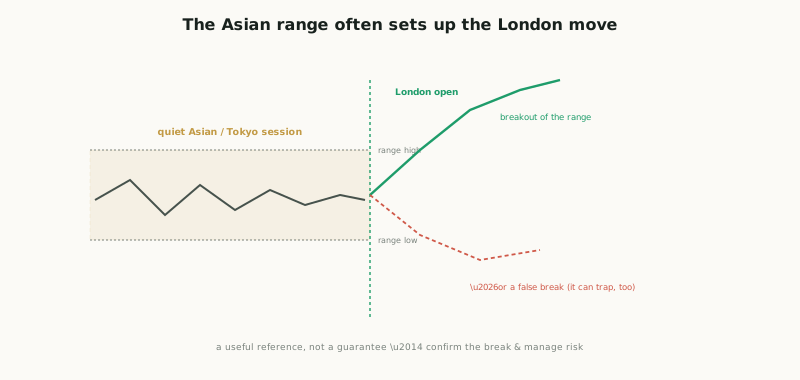
The Asian session range is the high-to-low range that forms during the Asian (Tokyo) trading session — typically the quietest of the major sessions. With lower liquidity and fewer big participants active (Europe and North America are asleep), many pairs — especially the European and dollar majors like EUR/USD and GBP/USD — tend to consolidate in a relatively tight range overnight, drifting rather than trending. The key insight is that this quiet range is not just dead time — it becomes a reference structure for the active day ahead. Traders mark the range's high and low as reference levels, because the more active London and New York sessions — when the big players arrive and liquidity surges — often break out of it. In effect, the market spends the Asian session "coiling" in a range, and then frequently "releases" out of that range when London brings the volume, so the overnight range's edges become the natural breakout levels and intraday support/resistance for the session to come. This gives a trader a concrete, objective piece of structure on which to base decisions — a framework for the day's first big move — rather than facing a blank, directionless overnight chart.
How traders use it, and how it traps
The most common use is as a reference for the London open. When London arrives and liquidity surges, price frequently breaks out of the overnight Asian range, so its high and low act as breakout levels and as intraday support/resistance for the rest of the day. Practically, traders use it in a few ways: some trade the breakout of the range as London opens (the basis of the London breakout strategy — buy a break above the range high, sell a break below the low), expecting the surge in volume to drive a directional move; others simply watch how price interacts with the range edges, treating them as key levels to lean on (a rejection of the range high is resistance; a hold above it, support). Either way, the Asian range gives structure to the day: it defines where "quiet consolidation" ends and where a meaningful breakout begins, which is genuinely valuable for intraday traders who need objective levels rather than gut feel.
But — as with every tool on this site — it's a useful tendency, not a guarantee, and it has specific failure modes worth respecting. Breakouts of the Asian range can be genuine or false: price may break the range, lure traders in, then reverse (a trap / false breakout), and this is especially likely precisely because the range edges are obvious, watched levels where breakout orders and stops cluster (exactly the liquidity that a failed break feeds on). A naive "buy every break of the Asian high" approach gets chopped up by these false breaks. There's also a pair-dependence caveat: the Asian range matters less for pairs whose "home" session is Asian — the yen pairs (USD/JPY and the yen crosses) and AUD/NZD can be genuinely active overnight (with Tokyo, Sydney and regional news driving them), so they may not form a tidy quiet range, and the "Asian range then London breakout" logic applies best to the European/dollar majors that are quiet overnight. The sound approach is therefore to treat the Asian range as a helpful reference to combine with confirmation — wait for a decisive break (a close beyond the range, follow-through, or a held retest) rather than the first poke, be alert to false breaks at these obvious levels, apply it mainly to the pairs it suits, and govern it all with risk management — rather than treating it as a standalone signal. Used that way, the Asian range is a high-quality piece of intraday structure; used naively, its very obviousness makes it a trap. The honest framing: the Asian session range is the tight high-to-low range that forms during the quiet Asian (Tokyo) session, especially in the European/dollar majors; its edges become reference levels because the active London and New York sessions often break out of it. Traders use it as a London-open breakout level and as intraday support/resistance. But breaks can be false (the obvious edges attract clustered orders and traps), and it matters less for pairs active overnight (yen, AUD/NZD) — so treat it as a reference to combine with confirmation and risk management, not a standalone signal.
Why the pattern exists, and refinements
The Asian-range pattern isn't arbitrary — it has a clear structural cause. During the Asian session, the major European and North American players (who drive most volume in the European/dollar majors) are asleep, so liquidity is low and there's little fresh directional flow — price naturally consolidates rather than trends. Then the London open brings a surge of volume and fresh participants, who often push price decisively out of the overnight range as they act on the day's news and positioning. So the "coil overnight, release at London" pattern is really just low liquidity giving way to high liquidity — understanding the cause helps you trust the pattern where it applies and recognise where it won't.
Several refinements make the Asian range more useful. Range width as a gauge: an unusually tight Asian range often precedes a larger London move (energy "coiled" more), while a wide, volatile overnight range is less reliable as a breakout reference — so favour clean, tight ranges. The first-break-fails tendency: it's common for the first push out of the range to be a false break (a stop-run) that reverses, with the real move coming on the second attempt — so patient traders often wait for a break, a fail, and then the genuine move (or trade the failure itself as a swing failure). Combine with the day's bias: a range break aligned with the higher-timeframe trend or the day's fundamental lean is higher-quality than one against it. And note the pattern is strongest when the London move extends into the London–NY overlap. The honest caveat remains: on major news days, or for overnight-active pairs (yen, AUD/NZD), the tidy range can fail to form or break meaninglessly — so the Asian range is a conditional tool, best on quiet-overnight European/dollar majors with confirmation. The honest reminder: the Asian range exists because low overnight liquidity causes consolidation that the high-liquidity London open then breaks; refine it by favouring tight clean ranges (a gauge of a bigger move), expecting the first break to often fail before the real move, aligning breaks with the day's bias, and noting it works best on quiet-overnight majors — not on news days or overnight-active pairs.
More than any single setup, the Asian range teaches a habit worth carrying everywhere: read the market's rhythm. Markets breathe — quiet, coiling periods give way to active, expansive ones — and learning to spot that transition (here, the overnight coil releasing at London) is a skill that applies far beyond this one pattern. Mark the range, wait for the genuine release, and you're trading with the market's natural rhythm rather than guessing in the dark of the overnight quiet.
The Asian session range is the tight high-to-low range that forms during the quiet Asian (Tokyo) session — especially in the European/dollar majors (EUR/USD, GBP/USD) — and its high and low become reference levels because the active London and New York sessions often break out of it. Use it as a London-open breakout level and as intraday support/resistance. But it's a tendency, not a guarantee: breaks can be false (the obvious edges attract clustered orders and traps), and it matters less for pairs active overnight (yen, AUD/NZD). So wait for a decisive break (close/retest, not the first poke), apply it to the pairs it suits, and combine with confirmation and risk management — a reference, not a standalone signal.