
Behind every major currency stands a central bank, and these institutions are the single most powerful force in the forex market. Knowing who they are, what they're trying to achieve, and — crucially — how they diverge from one another is the backbone of fundamental analysis. Almost every big, sustained currency move traces back to what these banks are doing or are expected to do. This guide introduces the major central banks: who they are, why they matter, and why their divergence drives pairs.
It puts faces to the concepts in central banks and monetary policy, sets up divergence, and connects to interest rates and the hawkish/dovish spectrum.
Key takeaways
Q: Who are the major central banks in forex?
A: The big ones are the Federal Reserve (Fed) for the US dollar, the European Central Bank (ECB) for the euro, the Bank of England (BoE) for the pound, the Bank of Japan (BoJ) for the yen, the Swiss National Bank (SNB) for the franc, the Bank of Canada (BoC) for the Canadian dollar, the Reserve Bank of Australia (RBA) for the Australian dollar, and the Reserve Bank of New Zealand (RBNZ) for the New Zealand dollar. Each steers its currency through interest-rate and monetary policy.
Q: Why do central banks matter so much for currencies?
A: Because they set interest rates and monetary policy, which are the dominant long-term drivers of exchange rates. Higher rates (or expectations of them) tend to attract capital and support a currency; cuts tend to weaken it. Central banks also shape inflation, money supply and market expectations through their communication. Since currencies are relative — always one against another — it's the comparison between two central banks' policies that matters most.
Q: What is central bank divergence and why does it drive pairs?
A: Divergence is when two central banks move in different directions — one raising rates while the other holds or cuts. Because a currency pair reflects the relative value of two currencies, divergence creates a powerful, sustained driver: capital flows toward the higher-yielding, tightening currency and away from the looser one. The biggest trends in forex often come from clear, lasting policy divergence between two major central banks.
Who they are
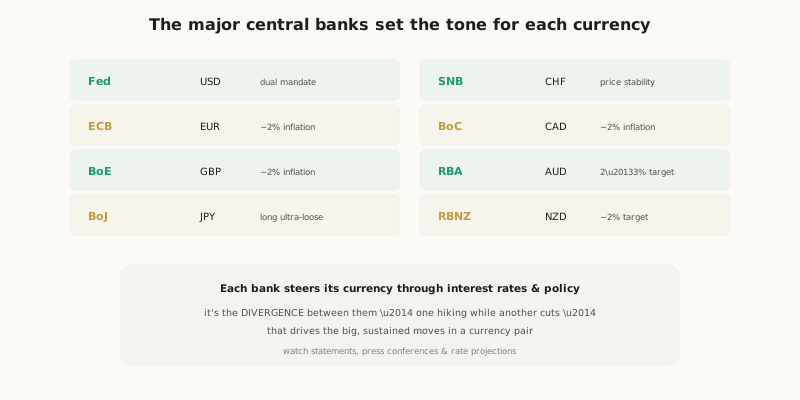
The big central banks each "own" a major currency and steer it through interest-rate and monetary policy:
| Central bank | Currency | Mandate / character |
|---|---|---|
| Federal Reserve (Fed) | USD | Dual mandate: stable prices + maximum employment |
| European Central Bank (ECB) | EUR | Primarily ~2% inflation, across the eurozone |
| Bank of England (BoE) | GBP | ~2% inflation target |
| Bank of Japan (BoJ) | JPY | Long era of ultra-loose policy; key for the yen |
| Swiss National Bank (SNB) | CHF | Price stability; willing to intervene |
| Bank of Canada (BoC) | CAD | ~2% inflation target |
| Reserve Bank of Australia (RBA) | AUD | 2–3% inflation target band |
| Reserve Bank of New Zealand (RBNZ) | NZD | ~2% inflation target |
The headline players are the Federal Reserve (the "Fed") for the US dollar — the most important of all, given the dollar's reserve status — the European Central Bank (ECB) for the euro, the Bank of England (BoE) for the pound, and the Bank of Japan (BoJ) for the yen. Then come the Swiss National Bank (SNB) for the franc, the Bank of Canada (BoC) for the Canadian dollar, the Reserve Bank of Australia (RBA), and the Reserve Bank of New Zealand (RBNZ). Most share a broadly similar goal — keeping inflation around a 2% target while supporting their economy — though the Fed notably has a dual mandate (price stability and maximum employment), which means US jobs data matters enormously for the dollar. Each bank has its own character and history (the BoJ's long ultra-loose stance, the SNB's readiness to intervene), worth knowing for the currencies you trade.
Why they matter, and the power of divergence
Central banks matter so much because they set interest rates and monetary policy, which are the dominant long-term drivers of exchange rates. Higher rates (or expectations of them) tend to attract capital and support a currency (global money chases yield — see the carry trade and capital flows); cuts tend to weaken it. Beyond rates, central banks shape inflation, the money supply (via QE/QT), and — critically — market expectations through their communication (forward guidance, the hawkish/dovish tone of statements and press conferences). Because of all this, the calendar of central-bank meetings is the most important schedule in the macro trader's diary, and the tone of a bank's communication often moves its currency more than the rate decision itself.
The single most important idea, though, is that currencies are relative — always one against another — so it's the comparison between two central banks' policies that matters most. This is the power of divergence: when two banks move in different directions — one raising rates while the other holds or cuts — it creates a powerful, sustained driver for their pair. Because the pair reflects the relative value of the two currencies, divergence pulls capital toward the higher-yielding, tightening currency and away from the looser one, and this can persist for months or years as the policy gap plays out. The biggest trends in forex often come from clear, lasting policy divergence between two major central banks (a classic example being one bank aggressively hiking to fight inflation while another keeps rates pinned near zero — a recipe for a strong, durable trend in their pair). This is why a macro trader watches not just one central bank but the relationship between the two behind any pair they trade: the question is never simply "is the Fed hawkish?" but "is the Fed hawkish relative to the ECB?" Understanding the major central banks individually — and then tracking how they diverge — is the backbone of trading currencies on fundamentals. The honest framing: the major central banks (Fed/USD, ECB/EUR, BoE/GBP, BoJ/JPY, SNB/CHF, BoC/CAD, RBA/AUD, RBNZ/NZD) each steer their currency through interest rates and policy, mostly targeting ~2% inflation (the Fed also has an employment mandate). They matter because rates are the dominant driver of exchange rates and their communication shapes expectations. Above all, because currencies are relative, it's the divergence between two banks — one tightening while another eases — that creates the biggest, most sustained moves in a pair, so track the relationship, not just one bank.
How to follow them
Following the central banks in practice centres on their meetings, which are the most important fixtures in the macro calendar. Each major bank meets on a regular schedule (often around eight times a year) to set policy, and each meeting typically delivers several things a trader watches: the rate decision itself (hike, hold or cut), an accompanying statement explaining the reasoning, often economic projections (the Fed's famous "dot plot" of where officials expect rates to go, for instance), and frequently a press conference where the chair takes questions. Mark these dates in advance — they reliably produce volatility in the relevant currency, and the days around a major meeting are among the most active (and riskiest) in forex.
The subtle but vital point is that the tone and guidance often matter more than the decision itself. Because markets price in expectations, a widely-expected rate decision may be a non-event — it's the surprises that move currencies: an unexpected decision, or, far more often, a shift in the bank's tone (more hawkish or dovish than expected), its forward guidance about future moves, or the chair's nuance in the press conference. A bank can hold rates exactly as expected yet send its currency sharply up or down purely on whether it sounded more hawkish or more dovish than the market was positioned for. Most banks today also stress they are "data-dependent," meaning each meeting's outcome hinges on the recent economic data — so following a central bank means following the data it's watching, and forming a view on how it will react. The practical workflow: know the meeting dates for the currencies you trade, follow the data feeding each bank's decision, focus on the tone and guidance (not just the headline decision), and — always — read it in the relative context of the other bank behind your pair. That combination is how a macro trader actually tracks the institutions that move their market. The honest reminder: follow the central banks through their roughly eight-times-a-year meetings — watching the rate decision, statement, projections (like the Fed's dot plot) and press conference — and mark those volatile dates in advance; but remember the tone and forward guidance usually matter more than the widely-expected decision itself (a bank can hold as expected yet move its currency on sounding more hawkish or dovish), most banks are "data-dependent" so follow the data they watch, and always read it relative to the other bank behind your pair.
Get comfortable with these eight institutions and the relationships between them, and you hold the single most useful map in fundamental forex analysis — because almost everything else in the macro world ultimately filters through what they decide to do next.
The major central banks — Fed (USD), ECB (EUR), BoE (GBP), BoJ (JPY), SNB (CHF), BoC (CAD), RBA (AUD), RBNZ (NZD) — each steer their currency through interest rates and policy, mostly targeting ~2% inflation (the Fed also has an employment mandate). They're the market's dominant force: rates drive exchange rates, and their communication shapes expectations. Above all, because currencies are relative, it's the divergence between two banks — one tightening while another eases — that creates the biggest, most sustained moves in a pair. So never ask just "is this bank hawkish?" but "is it hawkish relative to the other?" — track the relationship, watch the meetings, statements and projections, and you're reading the backbone of forex.